Category Archives: Cemeteries

Happy Birthday, Alfred Schreyer!

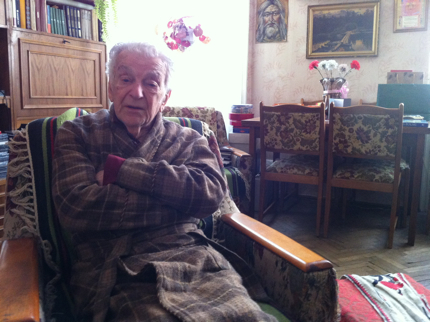
This is Alfred Schreyer, born on 08.05.1922 in Drohobycz. Alfred Schreyer, who lost both his parents – his father was a chemist, his mother a pharmacist – to the Nazis and was himself at the camps Plaszów, Groß-Rosen and Buchenwald, is the only Jewish survivor still in Drohobycz who lived there during the occupation.
Most of the Jews from Drohobycz were murdered in the extermination camp Belzec, as Alfred Schreyer’s father, his uncle, his grandmother and an aunt. But 11,000 of them, among of them his mother, were also shot in the forest of Bronica, outside of town on the road to Sambor.
Drohobycz is a small town in the Austro-Hungarian province of Galicia. Located in the N.E. Carpathian foothills in the east Galician oil region, economically and culturally diversified, Drohobycz was one of the most significant centers of Jewish culture in Europe preceding WW2. And now?
Alfred Schreyer was a student of Bruno Schulz, the world-renowned writer and painter and a Polish Jew, who experienced the terror of German occupation in the Galician city of Drohobycz in 1941-42. He initially survived by painting murals for the children of the SS officer Felix Landau, on the nursery walls of the villa they had occupied. Bruno Schulz was shot and killed by the SS on November 19, 1942. Despite an intensive search after WWII, his murals were not found until February 9, 2001, when the documentary filmmaker Benjamin Geissler discovered the long lost pictures. In May 2001, representatives of Jerusalem’s Yad Vashem Holocaust Memorial removed fragments of these murals from Ukraine, sparking an international controversy.

On November 19, 1942, the great Polish author Bruno Schulz left his home in the Jewish ghetto of Drohobycz – according to the generally accepted version of the story, he had gone to fetch a ration of bread – and was shot to death by a German SS officer. The author of two critically acclaimed short-story collections and a graphic artist of growing renown, Schulz had survived the Nazi occupation as long as he did under the protection of Felix Landau, a vicious Gestapo officer who fancied himself a patron of the arts…Click here to read the full thrilling story, edited by Benjamin Paloff for the Boston Review!

Im Gespräch: Alfred Schreyer. Wie haben Sie den Krieg überlebt, Herr Schreyer? Sobald das Scheinwerferlicht angeht, vergisst Alfred Schreyer sein Alter. Fast sein gesamtes Leben hat der achtundachtzigjährige Opernsänger an ein- und demselben Ort verbracht – und dabei in fünf Staaten gelebt….Click here for the outstanding interview with Alfred Schreyer, conducted by Helga Hirsch for the FAZ!

Kyseliv – Borivtsi – Verenchanka

Pawel Otulakowski wrote to us: “Hello! I am Polish man who travelled to Ukraina to find family roots. Some of them are in Kyseliv. This is what I find near the village – monument without inscriptions (photo). I heard from local people history of this tragedy. Germans takes all jewish people from two twin villages – Kyseliv and Borivtsi (Kisielów i Borowce). They find also few Ukrainians who for promise to take all goods from victims agree to shot them. But they were usual people who don’t know how to kill. So they shoted even few times and they don’t kill some persons. Germans look for this and have fun that ukrainians do that “unprofessionally” . Died and alived – all were throwed to the little water eye that was deep in this time. There were corn around and few people saw everything. Everybody knows who were murderer but they lived without any consequences. Now they are die. I think You have to know about this and hope that monument will be repaired. There is also few macevas/gravestones in Verenchanka (Werenczanka) cemetery (photo).”

First I thought it is off-topic and off-area, but on closer examination I learned, that it is at least not off-area, as Kyseliv, Borivtsi and Verenchanka belong to the Czernowitz region and the Kitsman district. Above all, it can’t be off-topic, as similar brutal massacres happened in the whole area and – as Jerome mentioned – “it is one of those horrible, believable stories that is crying out to be heard, regardless of where it took place.”
Edgar Hauster

Ph. Mr. Josef Focșăneanu (1861-1933)

In January 2011 I stated as follows: “Josef Focsaneanu, a very well known pharmacist in Sadagora, deceased on 13.01.1933 at the age of 72 years. We learn, that – among many personalities from Czernowitz and Sadagora – Josef’s three sons, Dr. Lazar Focsaneanu, Saki and Fritz Focsaneanu attended the mourning ceremony. We come across Saki’s name again in Hugo Gold’s “Geschichte der Juden in der Bukowina”:

“The summer of 1940 brought a great surprise with the marching in of the Soviet Russians, but also a great disappointment. The Sadagurans had hoped for deliverance from the Romanian Jew-hating regime, but the nationalization of the people’s possessions in the year 1940, from which the Jews were the most to suffer, was superseded in the spring of 1941 by the deportation of the so-called asocial elements, the so-called bourgeoisie, the small businessmen – there were no wholesalers any more – and the hard working trades people, who in their small businesses with a few workers and modern machines had achieved a modicum of success, and the Zionists. Many were jailed, like the pharmacist, Sacki Fokschaner, and the Jewish Gemeinde secretary, Josef Körner, who perished there. Many were deported to Siberia, such as Nathan Luttinger, Mosche Stupp, Hersch Roll, Mottl Katz, Jakob Rechter, Leon Brender, Leiser Metsch, Isak Beutel, and many others perished there with their families from hunger and cold.”

But who knows, perhaps there are still descendants of Josef Focsaneanu out there!?”

More than nine years later, in March 2020, Frank Fokschaneanu, Josef Focșăneanu’s great-grandson, contacted me by sharing details from his family history and the amazing family photo below. Frank’s grandfather Friedrich Fokschaneanu was the founder of the Goetheplatz-Apotheke in Munich. The family tradition persists!

NN, Josef Focșăneanu, Friedrich (Fritz) Focșăneanu, Sakhi Focșăneanu, Lazar Focșăneanu, NN

Moshe Barasch: Wunderkind & Art Historian

Begger – Moshe Barasch (Czernowitz 1920 – 2004 Jerusalem)

Barasch was born to Menachem and Gusta Barasch and grew up in Czernowitz. […] His father was a Zionist who introduced his son to the tradition of Haskala, the Jewish Enlightenment.

The young Barasch showed himself to have substantial art talent. By age 12, he had already exhibited his drawings and paintings in Czernowitz, Prague, Budapest and Boston, which he visited. He wrote daily in his notebooks, one of which was a diary. As a member of the Haggana, the Jewish military organization later to become the Israeli army, he used his artistic skills to forge passports for fleeing Jews. […]

Barasch was Senior Visiting Fellow at the Harvard Univ. Center for Italian Renaissance Studies (“I Tatti”), Florence, in 1969. He was appointed Jack Cotton Professor of the History of Art and Chair of of Institute of Fine and Performing Arts, Hebrew University in 1971, which he held until 1975, intermittently acting as a Visiting Professor and Research Associate at New York University between 1970-79. He was Senior Fellow at Cornell University’s Society for Humanities in 1981and the same year Distinguished Visiting Professor at the Pennsylvania State University.

In 1982 he taught as a visiting professor at the Freie Universität, Berlin. He published the first edition of his collected documents on the history of art theory in 1985. Between 1986-88 he taught at Yale University.  In 1987 he published his Giotto and the Language of Gesture, major contribution to the literature on that artist. He became emeritus in 1988.  In 1996 he was the recipient of the Israel Prize, and elected corresponding member of the Heidelberg Academy of Sciences. Barasch was the first Israeli art historian to attain worldwide recognition, lecturing widely at institutions in Europe and the United States (Freedman). […]

His lectures and books, many of which were written in Hebrew, helped to develop the art historical terminology in that language and drew attention to many of the themes that were to attract scholars in the humanities. Three generations of Israelis grew up on the books he wrote, edited.  He was also instrumental in having important art history texts translated into Hebrew. Francis Peters’ 1985 book on Jerusalem was dedicated to him and his wife.

Artibus et Historiae, Vol. 9, No. 17 (1988), pp. 127-135

Reflections on Tombstones: Childhood Memories

CLICK HERE FOR THE PDF DOWNLOAD OF THE ARTICLE!

Spuren, die vergehen [Vanishing Traces]

This richly illustrated book documents the search for the former Jewish presence in Satu Mare in the Northwest of today’s Romania. In 1944, Satu Mare’s Jewry was almost completely annihilated in the Holocaust. What is left are vanishing traces, mostly ruined Jewish cemeteries and shabby synagogues. These forgotten sites bear witness to the formerly proud Jewish presence in the region. On his journeys Simon Geissbühler is not only interested in the Jewish heritage and the Jewish microcosm of Satu Mare. He also discusses the history of the Romanian Jews in the 20th century, the Holocaust in Romania, the still almost inexistent culture of memory and remembrance in Romania, a country which was home to one of the most important Jewish communities in pre-World War II Europe. The author builds new inroads into what once was a thriving Jewish community and makes a world long gone rise again.