Author Archives: Edgar Hauster

Selma Merbaum – Ich habe keine Zeit gehabt zuende zu schreiben

cache_2449382754

Gabriele Weissmann: On Monday night the reading for Marion Tauschwitz’s new book “Selma Merbaum – Ich habe keine Zeit gehabt zuende zu schreiben” [I had no time to finish writing] took place at Berlin’s big book-store, Dussmann. Organized as a dialogue between Marion Tauschwitz and the well-known (and beautiful actress)  Iris Berben, introduced by the publisher. The room was packed, and the interest great. Selma’s poems are already quite well-known in Germany and often read in schools. They both read from the book, Marion Tauschwitz also giving a general view of her search for Selma’s background and  Iris  Berben spoke of her love for the poems. She was deeply impressed when she read them in Czernowitz, in the Chessed Shoshana hall, with Prof. Rychlo interpreting.  Berben then read “Poem”, in a personal, very moving manner, in which Selma’s  yearning for love, for life, her sensibility, her premonitions, are so well formulated.   At the end Iris Berben read part of her well-written introduction. Tauschwitz’ book is an insider’s view of Selma’s life and writing, with very accurate research into the family history. She has searched  family records,  read intensively documentation and literature on the subject, interviewed  persons in Europe and Israel, has corrected irregularities including Selma’s correct name. She describes Selma’s strong personality against the background of the social, cultural and political influences on the young girl’s spiritual development.  Her sensitive poetry, her hunger for life, her political views and her sight of the tragic events which took place in the last years of her life. The tragedy of the concentration camps… Selma, through Marion Tauschwitz’s book has become alive again. Her poems are world literature. A lot of applause at the end, and people literally rushed with the books for signature.

Marion Tauschwitz and Iris berben at Kulturkaufkaus Dussmann, Berlin, on 29.09.2014

Ein Radiobeitrag der ARD-Kulturkorrespondentin Maria Ossowski,

auf amazon die ersten Leserstimmen,

sensibel die Einschätzung auf haGalil von Ramona Ambs,

auch ein Literaturblogger hat Selma Merbaums Biografie schon gelesen,

und auch avivia – online magazin hat genau gelesen,

weiterhin eine Rezension von Christel Wollmann-Fiedler.

Read more on Marion’s (litera)tour guide for October/November 2014 at:
http://www.marion-tauschwitz.de/lesetermine/

Czernowitz-5-13 2782

The Czernowitzer Philipp Rubel at the Outbreak of WW I

ONB_F8ri

Exactly 100 years ago today, on July 5, 1914 the Austrian magazine “Wiener Bilder” leaded on the front page with a photograph, which became an icon of photography for the coming decades. It shows allegedly the capture of Gavrilo Princip, a Bosnian Serb who assassinated Archduke Franz Ferdinand of Austria and his wife and provided the pretext for Austria-Hungary’s invasion of Serbia, which then led to World War I.

But was the detained person really Gavrilo Princip? Who was the photographer? How did it come into the media? Questions upon questions! We get the right answers by the Austrian editor and photo historian Anton Holzer, who published his research under the headline “The Murderer, Who Wasn’t”:

http://diepresse.com/home/spectrum/zeichenderzeit/766288/Der-Morder-der-keiner-war

To make a long story short: It wasn’t Gavrilo Princip on the photo, but his schoolmate Ferdo Behr, mistaken for the assassin. The photographer remains anonymus, but the CZERNOWITZER, who brought this photo into orbit was PHILIPP RUBEL, who ran a small postcard publishing company in Vienna, Porzellangasse 60. Above all, Philipp Rubel is related to our fellow member Ken Cutler, who wrote to me in 2012:

“A complete bio of Philipp Rubel, from my standpoint is as yet not possible. What I do know is that he was one of 12 sibs from Cz. He moved to Vienna, married twice and his daughter, Erika, came to the US in 1939 and stayed with my cousin Stanley for about 1 year. Stan lost track of her and I tracked her down and found her son and his children, she passed by the time I found her. Philipp and his wife Sabine were killed or died in the Shoah and Erika made an application for reparations in Austria. I have the address where Philipp and I believe other family members lived from researches and it’s the address indicated at his death. That address matches the letterhead on his letters to Stan’s mother, Helen. He was born 12 Dec 1871 and died 26 Oct 1938. That address was 1090 Porzellangasse 60, Wien, Austria. You have me hooked now, what is the mystery??”

What a thrilling story, but unfortunately, dear Ken, although I tried hard, I didn’t succeed to discover more on Philipp Rubel. On the other hand I’m positive, that you – and others – will enjoy Philipp’s contribution to WW I.

image

Porzellangasse 60 in Vienna

Transnistria, Then and Now

The territory of Romanian-ruled Transnistria (1941-44, 42,000 km2 / 16,216 sq mi) is incongruent with and included present-day Transnistria (4,163 km2 / 1,607 sq mi). Learn more on that subject from the disambiguation effected by Daniel Katz by clicking here for a PDF download of Daniel’s presentation, including detailed maps and additional links.

Please remember, Fabius Ornstein’s testimony “The Suffering of the Deportees in Transnistria” is still available at our Blog! On Fabius Ornstein’s life-saving activity in Transnistria we learn from the Jewish Telegraphic Agency report dated July 26, 1943 as follows:

Thousands of Jews in Transnistria Have Not Seen Bread for Months, Hundreds Starving
Thousands of Jewish deportees confined in the various ghettos which the Rumanian occupation authorities have established in Transnistria, the Rumanian-administered section of the Russian Ukraine, have not seen any bread for months and the vast majority of them are threatened with starvation unless some assistance is forthcoming soon, according to private advices received here today. In the township of Copaigorod about 2,220 Jews are confined at present, the report discloses. Under the leadership of one of the deportees, Fabius Ornstein, the Jewish community has organized a free kitchen which has so far managed to distribute about 500 meals twice daily. These ‘meals,’ however, almost always consist of potatoes and nothing else. […]

Maps of 2 territories named TransnistriaMaps of 2 territories named Transnistria1

“I Remember Them Now” by Laurence Salzmann

Blue Flower Press: In the late 1930’s, there were eight thousand Jews in Rădăuți, a small town in the Bukovina region of Romania. During 1974-76, when the photographer/filmmaker Laurence Salzmann went to Rădăuți on a Fulbright Fellowship, there were only two hundred and forty Jews among the entire population of twenty-two thousand.

“I Remember them Now” is a short film made from newly rediscovered, kodachromes and audio from the Salzmanns’ original time in Rădăuți.

Football in the Vanished World: Bukovyna Chernivtsi

Guest post by Michael Hudson, originally published at The Accidental Groundhopper on 12 October 2013 and reposted by courtesy of the author. Thank you so much, dear Michael!

“English games are played, as out on the vast exercising ground we saw football in full swing, several games going on”. 

“I also played a bit of football, near our house there was a football field; it was the town’s football field, called Maccabi. We had a really good football team. Sports…were very popular among the Jewish organizations”.

For almost two centuries the eastern gateway to the Habsburg Empire, Bukovina was ceded to Romania between the two world wars and is now one of the sleepiest parts of south-western Ukraine.  Two hundred kilometres south of Lviv, and a four-hour bus ride from Suceava across the EU border, Chernivtsi, the quirky, down-at-heel provincial capital,  was formerly known  as Little Vienna and Jerusalem on the Prut; the second city of Austrian Galicia, Czernowitz /Cernăuți was a cosmopolitan mélange of ethnicities, home to Romanian, German, Ukrainian, Yiddish and Polish speakers,  the birthplace of the poet Paul Celan, and one of the first places in modern day Ukraine to embrace the sport of football.
2013_0504Lviv0078

The first organised team Turn- und Sportverein Czernowitz, was founded by German students in the autumn of 1903,  the black and whites outlasting several name changes and two  losing appearances in the semi-final of the Romanian Cup until they were finally broken up in 1940, when the entire German-speaking population, including the playing staff and officials of  Fußballsektion Jahn Czernowitz, was forcibly transported out of Bukovina in the wake of the Nazi-Soviet pact.  Many Bukovinan Germans settled in or around Stuttgart, their sporting legacy surviving with TSV Jahn Büsnau, who currently play in a district league at the twelth level of the German football league.
2013_0504Lviv0079

 A Polish team, Polonia Cernăuţi, was established after the German club splintered in 1912, and went on to become the region’s dominant force during its twenty-two years in the Kingdom of Romania.  Despite rarely owning a stadium of its own, Polonia spent three seasons in Divizia A, won the Bukovinan regional championships and held the Romanian national side to a 1-1 draw in front of 12,000 spectators in September 1922 before they too were dissolved in 1940. Fotbal Club Dragoş Vodă Cernăuţi, the favoured team of the city’s Romanian speakers, won the Bukovina championship four times between 1925 and 1933 but managed only a single season in the national top-flight, during which they won four out of eighteen games.  They did, though, share briefly in the development of Cernăuţi’s most famous footballing son, Alfred Eisenbeisser transferring from Jahn shortly before representing Romania at football at the 1930 World Cup .  Appearing against Peru and Uruguay,  Eisenbeisser contracted pneumonia on the return journey and was forced to stay behind when the ship docked at Genoa.  Rumours of his death spread through Bukovina; when he finally reached home, he found his mother busy preparing the funeral arrangements.  Eisenbeisser recovered sufficiently  to place thirteenth in the figure skating championships at the 1936 Winter Olympics, win another seven caps, and turn out over 140 times in the colours of Venus București.  Venus, like Dragos, were wound up in the late-1940s, having won eight national championships before Romania entered the war.
2013_0504Lviv0095

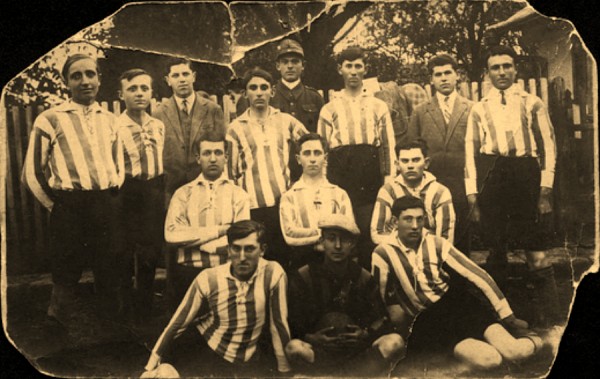
In 1919, when the region was annexed to the Kingdom of Romania,  Czernowitz’s Jewish population  had reached almost 30,000 people – or a third of the entire town.  The city twice elected Jewish mayors, streets were named after Jewish authors, rabbis and prominent city councillors, the first ever Yiddish [Conference] was hosted there in 1908, and the community’s two club sides,  Maccabi and Hakoah Cernăuţi, enjoyed regular success in regional competitions.
5121908_original

Maccabi, the oldest, had first taken to the field in 1909-1910, and would later supply a Romanian international of their own when Isidor Gansl, formerly of Fernencvaros [Ferencváros] and Hakoah Vienna, was capped against Turkey in 1923.  Hakoah played their first competitive game in 1920, and reached Divizia A and the Romanian Cup quarter-finals before they were subsumed by Maccabi eleven years later.  In 1932, a victory over Jahn resulted in a pitch invasion during which Maccabi players were attacked by supporters carrying revolvers shouting “Jews go to Palestine!”  By 1941, the team had been disbanded and many of its players transported to camps.  When the Soviets rolled back three years later, almost 50,000 Bukovina Jews had perished, either shot out of hand or loaded in to cattle trucks.  Jewish Czernowitz vanished in all but memory, its synagogue turned into a cinema six years after Celan published ‘Todesfuge‘ (Death Fugue):  Death is a gang boss…his eyes are blue. He shoots you with leaded bullets, his aim is true. 
2013_0504Lviv0075

Eight years after the traumatised city was incorporated into the newly-expaned Ukrainian Soviet Socialist Republic, Bukovya Chernivtsi emerged.  In 1958, a team including veteran inside-right Evgeny Archangelskiy, scorer of four goals during Dynamo Moscow’s 1945 tour of England, made its first appearances in the Soviet League.  Three decades later, with the Soviet Union on the verge of dissolution, Chernivtsi finally made their mark on the national stage, finishing in fifth place in the 1991 First League, a division which included Rotor Volgograd, Kuban Krasnodar, Zenit St Petersburg and Tavria Simferopol, the surprise first champions of independent Ukraine.  Present in the top-flight of Ukrainian football for three seasons, the yellow and blacks were relegated along with Metalist Kharkiv in 1993-94 and have since spent eleven seasons in the second tier and the same number in the third.  Narrowly surviving extinction this summer, survival is an achievement in itself in a country where four of the original twenty top-flight clubs no longer exist in any form whatsoever.

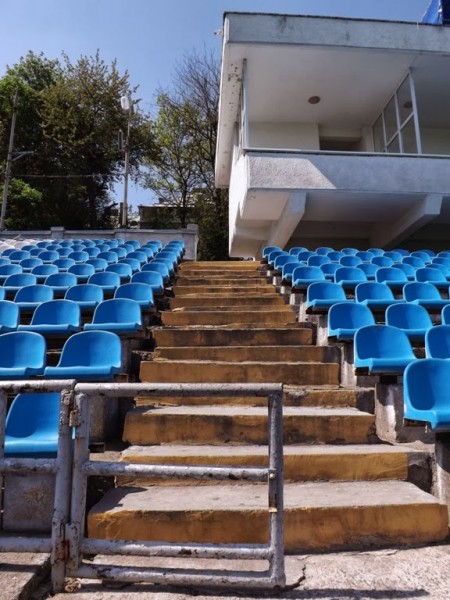
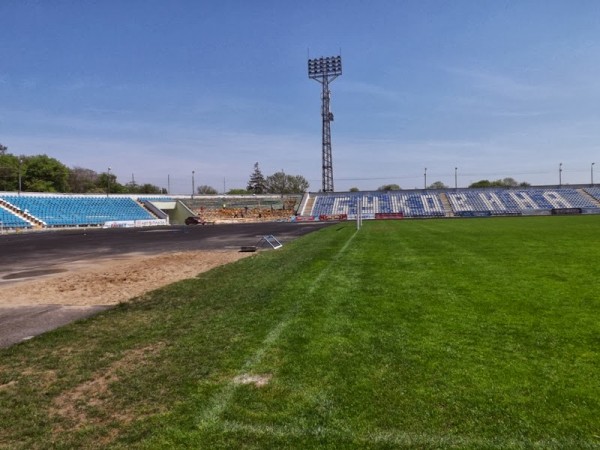
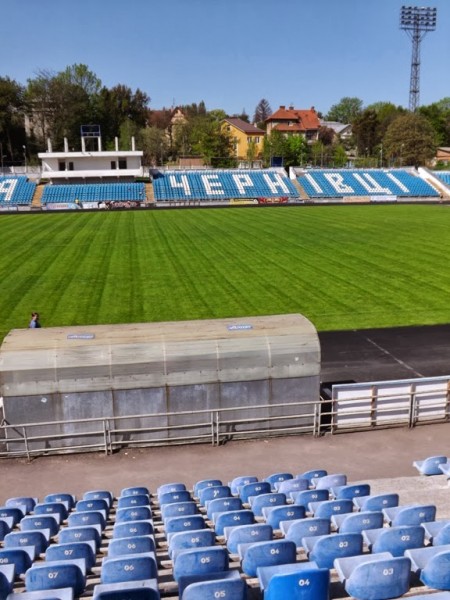
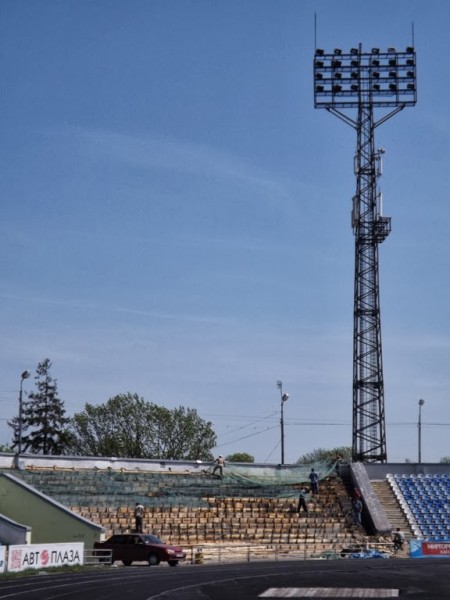
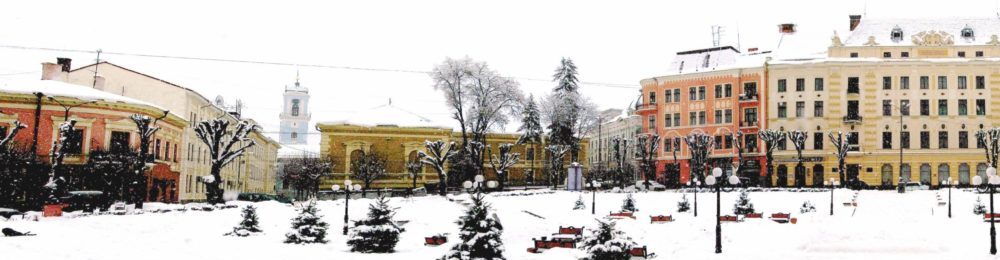
Chernivtsi has recently spruced itself up, with its red-brick university added to the UNESCO World Heritage list in 2011 and both Central Square and the nearby Olga Kobylianska Street repaved and pedestrianised. The football stadium is just off Holovna, a ten-minute walk from the centre on the other side of Shevchenko Park.  The Bukovyna, the city’s fanciest hotel, is directly opposite, the bus station another ten minutes up the road.  When I went there, the stadium was empty except for a small group of workmen repairing seats and three sprinters practising their starts.  On a dirt pitch next to the ground, a shirts against skins game had just got underway.  I watched from the top of the uncovered stand, dust and sunflower shells blowing across my feet.
Rohatyn and Bukovina Memorials at the Kiryat Shaul Cemetery in Tel Aviv

1

Marla Raucher Osborn at the Kiryat Shaul Cemetery in Tel Aviv, with Rohatyners standing before the Rohatyn Memorial to the victims of the Shoah

Nash Holos Ukrainian Roots Radio broadcast on “Ukrainian Jewish Heritage – Rohatyn”


OLYMPUS DIGITAL CAMERA

Bukovina Holocaust Memorial at the Kiryat Shaul Cemetery in Tel Aviv

JEWISH GALICIA & BUKOVINA: Galicia and Bukovina were major Jewish centers as far back as the 13th Century and were home to over one million Jews, with unique cultural characteristics and a vibrant intellectual and spiritual life. These regions produced prominent Jewish thinkers, rabbis and Hassidic courts, who created influential texts and institutions that have had a long-lasting impact on the Jewish world. The Torah scholars and Jewish intellectuals of Galicia and Bukovina were known for their tolerance and openness towards modernity, while being firmly rooted in Jewish tradition and learning. This thriving Jewish world was wiped out in the Holocaust.

First Autobus Lines in Czernowitz

Autobuz_pt_Cernauti_inainte_de_livrare_1933

Autobus in Brașov in 1933 before delivery to Czernowitz

Putting into operation of 10 autobuses, bearing the car numbers 310-319 by I.E.C.M. [Electromechanical Corporation of the Municipality of Czernowitz] on August 26, 1933, servicing three permanent and two seasonal bus routes. The autobuses, Type Fiat 622, assembled in Brașov, were dark red, had a 45 HP engine, 19 seats on luxury leather benches, ventilation systems and double doors, manually or automatically operated by the driver. The bus garage has been erected next to the tramway depot.
Source: http://www.transira.ro/bb3/viewtopic.php?t=4706

Autobuze_Cernauti

Autobuses in Czernowitz in front of the bus garage

Cz.Map_Tram+Bus_1935

Short-range transit in Czernowitz during the pre-WW2 period

330906c1 Kopie

“Der Tag”, Czernowitz, September 6, 1933 edition

Der Omnibus

Durch einige Hauptstraßen der Stadt eilt seit einigen Tagen der städtische Omnibus. Der Anfang ist gemacht: Das Verkehrsnetz der Straßenbahn ist um wenige Linien erweitert worden. Daß es nicht Straßenbahnlinien sind, die, die mit der elektrischen Tramway befahren werden, sondern Omnibusse, tut weiter nichts zur Sache, denn nach den äußeren Erfahrungen des Straßenbahnverkehrs ist die Ersetzung von Straßenbahnlinien durch Omnibusse praktisch, rentabel, dem Verkehr zuträglicher und für das Publikum geeigneter. Was seit Jahren angestrebt wurde, nämlich die Erweiterung des Straßenbahnnetzes, ist also endlich durchgeführt, man muß sich über diese Errungenschaft freuen und die Tat soll anerkannt werden.

Aber was wir mit Bedauern sehen, ist, daß das Publikum den Omnibus meidet, jedenfalls zaghaft den Straßenbahnwagen betritt und im großen und ganzen eine abwartende Haltung einnimmt. Seit mehr als dreißig Jahren ruft die Stadt nach der Erweiterung des Straßenbahnnetzes, endlich ist die Ausdehnung erfolgt, aber für den Czernowitzer gilt hier das Wort: Omnibus ist Omnibus und Tramway ist Tramway. Oder im weiteren Sinne: der Omnibus ersetzt nicht die Tramway. Es ist eine Auffassung, die dieser Stadt paßt und es wäre ein Wunder, wenn es anders wäre. Aber man darf nicht verzagen, hier muß Erziehungsarbeit geleistet werden, es muß dem Czernowitzer beigebracht werden, daß er endlich das hat, wonach er seit Tag und Jahr schreit, das moderne und billige Verkehrsmittel, das alle Verbindungen kreuz und quer schafft und das berufen ist, den Verkehr und damit auch das wirtschaftliche Leben zu fördern. Es muß auch hier der Grundsatz gelten, daß nicht der Verkehr die Tramway geschaffen hat, sondern die Tramway den Verkehr schaffen muß, und daß das, was heute leider noch nicht zu hören ist, nämlich die Zunahme des Verkehrs mit dem Omnibus, in paar Wochen oder in paar Monaten eintreten wird. Diese Erziehungsarbeit muß die Tramwaydirektion vornehmen. Dazu ist notwendig, daß der Omnibus sich auch an bestimmte Abfahrtzeiten gewöhnt, nicht an einer Station stehen bleibt und eine Ewigkeit wartet, bis genug Gäste kommen, ferner daß die Station genau bezeichnet wird, also richtige Haltestellen etabliert werden, kurz, daß der Verkehr in ein System gebracht wird. Es darf nicht geschehen, daß die Konkurrenz heute und morgen auf den neuen und schönen Omnibus, eine Zier des Stadtbildes, höhnisch und verächtlich weise, als ob Czernowitz in einem Anfalle von Größenwahn sich einen modernen Omnibus angemaßt hat, der ihm nicht gebührt – nein, das darf nicht sein. Der Omnibus ist eine Notwendigkeit, kein Luxusstück, sondern so notwendig wie das Wasser. Es darf die Gemüsefrau von Rosch sich nicht vom Verkehr fernhalten. Der Omnibus ist nicht für die reichen und eleganten Menschen, sondern für das Volk da. Und weil es so ist, muß auch die Tarifbestimmung sich diesen Erfordernissen anpassen. Wir sehen, daß auch die Organe sich mit dem Omnibus nicht richtig befreundet haben. Der Schaffner sitzt im Wagen, wenn die Station kommt, er muß bei der Station aussteigen, beim Aus- und Einsteigen behilflich sein. Es muß also der richtige Dienst am Kunden versehen werden. Es sei das Geständnis abgelegt, daß wir für den Omnibus die größte Propaganda führen wollen, gerade deshalb, weil er noch heute gemieden wird. Der konservative Czernowitzer soll sich zuerst an das neue Verkehrsmittel gewöhnen und bald wird der Omnibus zu dieser Stadt so gehören, wie Czernowitz ohne den alten Rathausturm nicht zu denken ist.

Ego.