


 Discover
 2016 Hilde Domin Prize for Literature in Exile awarded to Edgar Hilsenrath


Edgar Hilsenrath: “The city of Heidelberg’s 2016 Hilde Domin Prize for Literature in Exile has been awarded to German-Jewish writer Edgar Hilsenrath (born 1926). The accolade is awarded every three years to writers who live in exile in Germany, or who have been affected by the issue as descendants of exiles, who tackle the theme of exile in their literary work and who publish in German. In granting the award, the jury stated, ‘In Edgar Hilsenrath, we are honouring a writer whose life’s work has been to communicate the experience of exile through original and daring literature. His novels, which are driven by bleak, dark powers of imagination, are attempts to find ways to speak of the horrific acts humans commit against each other through various forms of the grotesque. His stories are best symbolised as laughter that gets caught in your throat – somewhere between cynicism, sorrow and assertiveness.’”
Marion Tauschwitz: I had the chance and pleasure to talk to him and to give him my biography on Selma Merbaum, he was very interested in. He and Selma could have met at Moghilew-Podolks where Selma stayed for a short while before being deported to cariera de piatra.
The Boyanner Rabbi
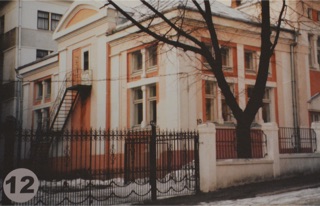
Ian Beitel / ianbeitel@sympatico.ca: “I believe that this building was the home of the Boyanner Rabbi. The rabbi arrived in Czernowitz from Vienna. He was the son of the first Boyanner rabbi who fled to Vienna after the Russians invaded Boyan at the beginning of WW1. Does this building still exist? His shul was adjacent to his home. Would anyone have photographs of the synagogue and of the street that it is/was on? What was the name of the street? Your help is greatly appreciated.
Presentation by Ruth Glasberg Gold

Eat In Good Health! Czernowitzer Challah
It Is Time
Today the curtain falls at the 40th edition of the Duisburg Documentary Film Festival. It is one of the important festivals for German-language documentary film, rich in tradition and valued by visitors for its laid-back atmosphere. This year the festival took place under the motto “Es ist Zeit” [It is time] between 7 – 13 November 2016. Selected knowingly or not by the festival organizers, “It is time” is at the same time the concluding line for Paul Celan’s poem “Corona” as translated by John Felstiner in Paul Celan: Poet Survivor Jew. Beyond the festival’s motto, two films are directly or indirectly related to Czernowitz.
The Dreamed Ones by Ruth Beckermann, whose father was born in Czernowitz.

Festival Director Werner Ružička, Ruth Beckermann

Landstück by Volker Koepp, the author/director of “Mr. Zwilling and Mr. Zuckermann”, “This Year in Czernowitz” and “In Sarmatien”.

Festival Director Werner Ružička, Volker Koepp

Literary Supplement: Corona by Paul Celan, translated by John Felstiner in Paul Celan: Poet Survivor Jew.
Autumn nibbles its leaf right from my hand: we’re friends.
We shell time from the nuts and teach it to walk:
time turns back into its shell.
In the mirror is Sunday,
in dream goes sleeping,
the mouth speaks true.
My eye goes down to my lover’s loins:
we gaze at each other,
we say dark things,
we love one another like poppy and memory,
we slumber like wine in the seashells,
like the sea in the moon’s blood-beam.
We stand at the window embracing, they watch from the street:
It’s time people knew!
It’s time the stone consented to bloom,
a heart beat for unrest.
It’s time it came time.
It is time.
Personally, I do have a high affinity for Paul Celan’s poem Corona. Read more at: “John Cage, Paul Celan, John Felstiner and Edgar Hauster in Halberstadt”.
Sadagora Synagogue: Restoration Completed
Additional links:
http://tinyurl.com/jqmnl75
http://tinyurl.com/zdek3rs
https://goo.gl/O5HKgN
https://goo.gl/GtN8MK
Retrospective view:
1993 – http://www.kehilalinks.jewishgen.org/sadgura/reesphotos.html
1998 – http://kehilalinks.jewishgen.org/sadgura/sadg02.jpg
1998 – http://kehilalinks.jewishgen.org/sadgura/sadg03.jpg
1998 – http://kehilalinks.jewishgen.org/sadgura/sadg04.jpg
2004 – http://gr-czernowitz.livejournal.com/1845900.html
2013 – http://ehpes.com/blog1/?p=6845
To be a Bukovinian (2016)

CLICK ABOVE TO READ MORE

CLICK ABOVE TO READ MORE

CLICK ABOVE TO READ MORE

CLICK ABOVE TO READ MORE
Contact: Carol Elias <carol8helen@gmail.com>
Joel (Ioil Ben Schmuel) Schmatnik
 In some terrific databases on the ehpes site I have found the 1936 address of my great-grandfather Joel (Ioil Ben Schmuel) Schmatnik’s shop. It was a “Galanterie” which translates to “Dry Goods” or “Haberdasher”. Joel was born around 1870 in Sadagora and died June 2, 1941. His kids were Max, Samuel (my grandfather), Sabine, Sigmund, and
five others. His brothers were Morris and Josef.
The 1936 address for the Schmatnik Dry Goods was General Zadik #4 (Romanian address). According to the street name table on Czernowitz Blog, it seems that the old German street name was Senkowiczgasse, or Senkoviczgasse. […] I would love some help if anyone is aware of this neighborhood, and nearby attractions, so I can find some photos online and get a better idea of how the neighborhood looked for my blog. […]
Iris AlRoy (mermamma@gmail.com)
Bukovina Classroom Map from the Year 1897


Additional Links
Ehpes Map Collection: http://czernowitz.ehpes.com/maps/index.htm
Czernowitz on Mapster: https://goo.gl/MVDHjp