Category Archives: Uncategorized

Meisler School Class III 1939-40

From Oren Saraf — this photo from his Aunt’s album…

Return with Ehpes to those wonderful? days of yesteryear — Did you attend the Meisler School in 1939-40? Unlikely, but possible. Do you recognize anyone, or think you recognize someone?  Oren says his aunt Lotte sits just left of the sign board.

Click on the photo to enlarge

Czernowitz -Meisler School 1939-40 from Oren Saraf

Czernowitz -Meisler School 1939-40 from Oren Saraf

1938 Maccabi Football Club?

From Gabriele Weissmann…

I found this [among] my uncle’s photos. I wonder if anybody recognizes a person. Also, in the background, a building which looks solid enough to have survived the war. Maybe it still stands. I believe it is a Maccabi football team. On the back of the photo is says only “Czernowitz 1938”.
Gabriele

IMG_20140727_0001
Click photo to enlarge

Important Czernowitz Dates

From Gaby Rinzler — regarding the list discussion about ‘important Czernowitz dates’:

In an attempt to leave my children and grand children information about my past I made a Geopolitical introduction. It may be pertinent to the present discussion re: what 1848, 28 of March 1914 and 1944, etc. meant to our group.

[Note* See List Archives on the website 2014 Archives II, starting June 27th 2014 for the discussion — Subject: 28 June 1940.]
rinzler1a
rinzler2

Yom Hashoa

I am in Florida for a long weekend with my wife. We walked into the Beth David synagogue in Palm Beach Springs for a Yom Hashoah observance which we heard was taking place. There was a small turnout of people reading names out loud, the entire day, of those who perished. My wife and I were asked to read names for 20 minutes. Not knowing my past, we were handed a list of names to read of those who perished from Romania in Transnistria. Irony or coincidence? I included names of my mother’s brother – Leopold End, her father – Lazar End, and her step mother -Sali End.

We should never forget. I have been told that one can forgive without reconciling. Perhaps I will try this one day. Perhaps.

May the blessed memories of those who perished never depart.

Stephen Winters

A Shtetl in the Caribbean

Read more and contribute to the realization of the project at:
http://www.cinecrowd.nl/een-sjtetl-de-cariben?language=en

Mark Wiznitzer: “Language and culture are so intertwined. My father left Vascauti (Vashkivtsi, Vashkowitz) 40 km from Czernovitz in Bukovina in 1927.He attended cheder and did not have the opportunity to complete his education because he left Romania with his older brothers while in his mid-teens. But he eventually learned to do business in 7 languages, including Japanese. But Yiddish was his first language, in which he wrote to his brothers using Hebrew letters. My maternal grandmother, having finished gymnasium in Dresden where my mother was born, and her Polish-born university-educated husband, spoke German. But their other European languages came in handy as they had their other children in France and Belgium, and settled first in Colombia, and ultimately in Curaçao. To assimilate, my grandfather added “Montevenado” to his name, a Spanish translation of his surname. And so the name on his gravestone in the ancient Jewish cemetery Beit Haim Blenheim reads “Max Hirschberg Montevenado”. My mother, having received a Dutch education in Curaçao was fluent in several languages. But she did not learn Yiddish until she and my father made it through WWII in Japan, where they lived with my father’s cousin from Czernovitz and socialized with other Jews from Eastern Europe, as well as Iraq and Syria. When my parents returned to Curaçao in 1946, Yiddish came in handy as the language of the growing Ashkenazi community, which had reached a sufficient critical mass to resemble a “Shtetl”. In Curaçao we Ashkenzi Jews were callled “Polacos” because the first to arrive came from Polish Galicia, ironically from Snyatin, immediately across the Cheremosh river from, and the nearest town to, my father’s birthplace. My childhood classmate, Sherman de Jesus, lived near our community’s Shaarei Tsedek synagogue and social Club Union. He was fascinated by our community early on. A successful documentary producer and director, he is now completing a film project on the Shtetl in the Caribbean. At the link above, there is a clip of some scenes shot so far in Bukovina, Belarus and Israel.”

Lyceum Mihai Eminescu


From Gaby Rinzler:

In the center is Professor Goraj,director and co-owner of the private lyceum Mihai Eminescu.

Gaby-hs

It looks like a graduating class (because of the glasses in their hands)
It is probably 1939-40. I can’t remember how I got in this picture. I am the obviouly younger kid with the open mouth. Many of the boys look very familiar to me but I cannot afix names to them. The big head on the right lower corner may be a cousine of mine Arno Rosenwald..

[I wish to see] if any body recognizes somebody?

Gaby

More on Movie “In Sarmatien”

From Gabriele Weissmann

Dear all,
Last week Volker Koepp invited us to the Berlin premiere of his new
movie “In Sarmatien” which took place in the Akademie der Künste. We
were very impressed. It is a superb documentary.
The many facets of the film are overwhelming. Its humane approach, its
references to history, to the past of peoples and the ensuing destinies,
should be a must-see for the contemporary generation and the educational
system world-wide.

It so happened that the premiere fell on a day when the events in Crimea
and the Ukraine were hot and moving fast.In the film,
Koepp interviews persons from Moldavia(Kisinau)Bielorus (Grodno)
Ukraine (Czernowitz),Lithuania, Kaliningrad (Königsberg) : and
everywhere the persons talk about their dreams for a better life, the
economical and political problems of the present situation,
and some, of their fears of a Russian takeover.

Considering the current events in Eastern Europe,this film is amazing.

In the trailer shown on today’s List, next to Tanja Kloubert,we see and
hear Felix Zuckermann, the son of Frau Zuckermann from the former movie.
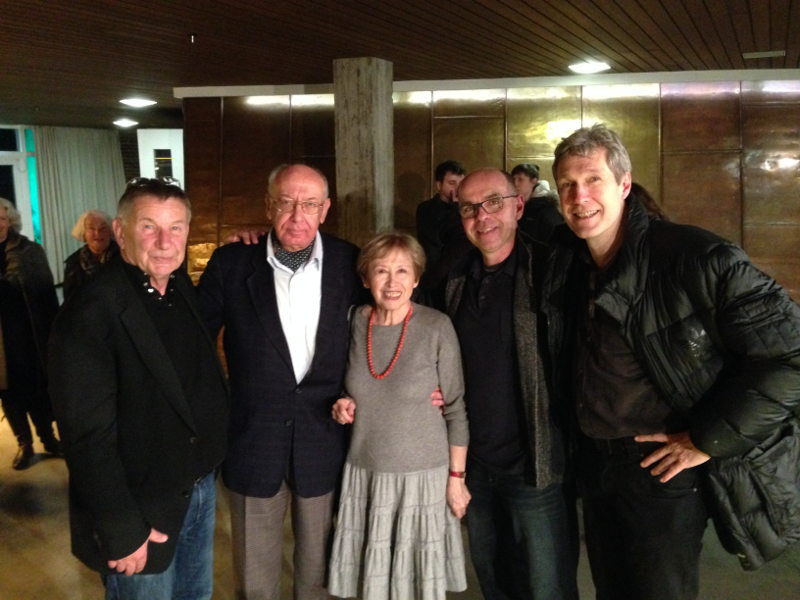
weissman

In the photo (click to enlarge), you will see Volker Koepp first on the left, my
husband and myself, and on my right,Fritz Hartthaler, the producer of
many Koepp documentaries, which are acclaimed all over the world.)

Not in the picture is Thomas Plennert, the outstanding cameraman, who
contributed to Koepp’s films for many many years. His masterly hand
at rendering landscapes as breathtakingly live paintings, and showing
people’s faces in their truthful, natural expression enriched Koepp’s
movies to make them cineastic works of art.

Koepp has a very personal way of asking and getting answers, of looking
intensely for people and places, thus painting a very complex picture of
his documentaries. Koepp genuinely likes people and their stories,
is interested in them, and he gets a most rewarding feed-back.

Have just heard today that the DVD will be on sale as from September
2014 (www.salzgeber.de/info@salzgeber.de).

Ten years ago, on the occasion of my husband’s 60th birthday party,
my husband finished his speech with this message:

” – We try to find answers to the questions of the present: All of us!
– We try to decipher the mysteries the future holds in store for us: All
of us!
– Only occasionally we remember that we are made of the dough of the
past. All of us!

Gabriele
Who Knew Hermann Schimmer?

From Corinne Schimmer:
[click on photos to enlarge]

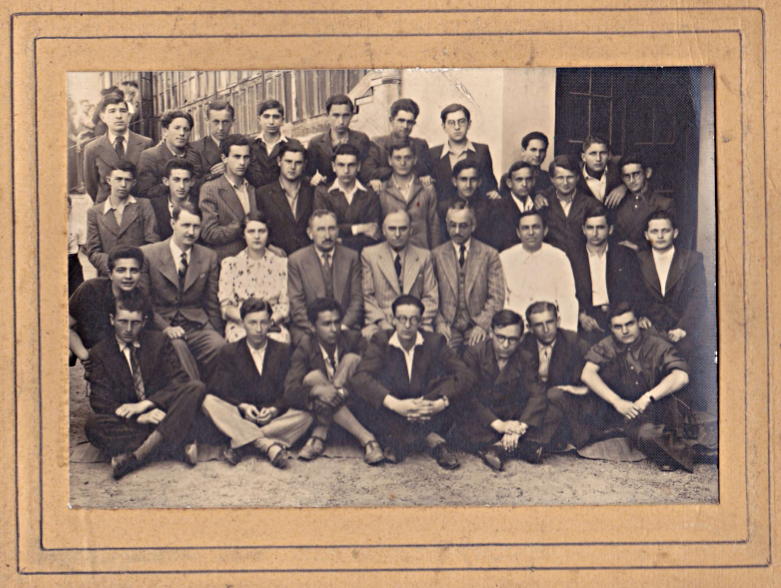
Corinne is trying to find anyone who knew her father, Hermann Schimmer, from Czernowitz.

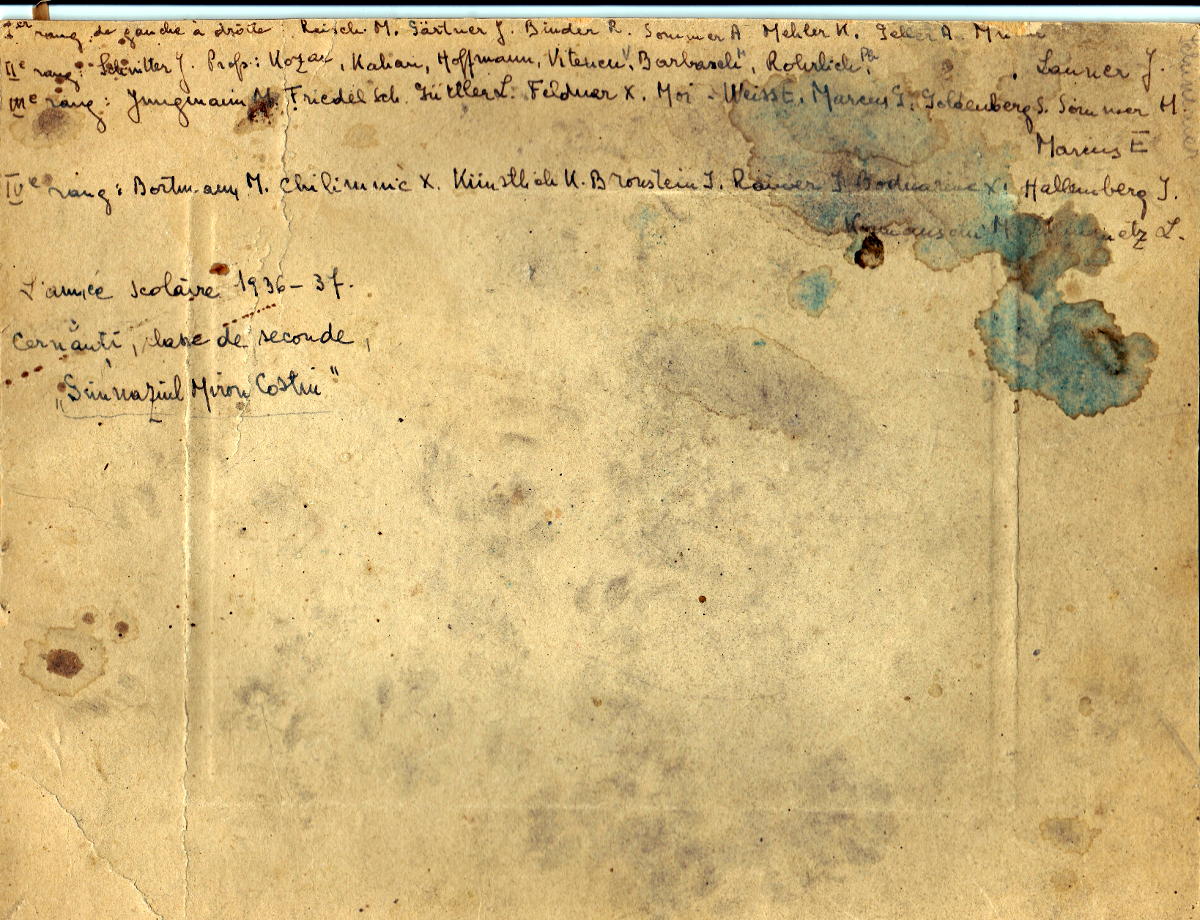
The first photo, front and back were taken in Gimmaziul Mirou Costiu (?) in 1936/37. Corinne says: ” My dad wrote the names on the back: he is in the third row [5th from the left]”.
Front:
1front
Back:
1back

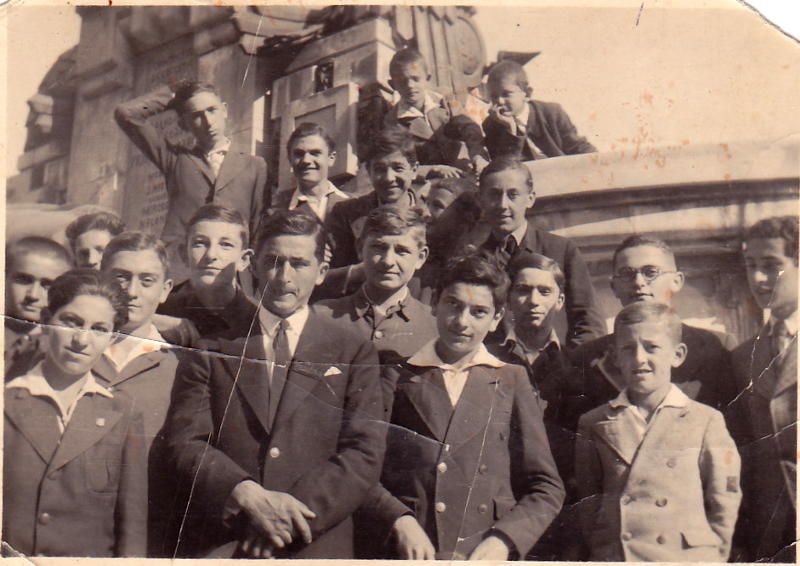
The second photo is of Class 1935 My dad is second from the right in the front row:
cz1935

The last photo is of my grandmother born Eva Hilsenrathe. It would be great if anyone could remember a name or anything!
EvaHilsenrath

Corinne Schimmer,
Caen, France