Tag Archives: Documents

Emperor Franz Joseph Jubilee Orphanage for Israelites in Czernowitz

IMG_0354Click on the front cover to download a PDF version of the booklet!

Hugo Gold, History of the Jews in the Bukowina, The Oldest Societies, Institutions and Organizations of Bukovina by Prof. Dr. Erich Neuborn, Tel Aviv, p. 153: “The opening of the Jewish Orphanage, took place in 1904/1905. Already in 1898 on the occasion of the 50th anniversary of the reign of Emperor Franz Joseph I, the idea of building an orphanage in Czernowitz was discussed and an executive committee was formed to raise the necessary funds. Members of this committee were among others, Markus and Rachel Schlaefer, Benjamin, David and Jetti Tittinger, Loebel and Cecilie Salter , Josef Steiner, Jakob and Toni Gold, and Dr. Benno and Fanni Straucher It wasn’t until 1904, that the orphanage on Franzosgasse was completed when the Heinrich and Josefine Wagner endowment of 662,928 crowns was activated and used for the construction of the orphanage. The festive opening of the orphanage was attended by the Austrian Minister President, Dr. Ernest von Koerber, the Bukovina State President, Prinz Konrad Hohenlohe and the Greek Orthodox Archbishop and Metropolitan, Dr. Vladimir von Repta. In 1913 the orphanage was legalized for the second time as the Emperor Franz Josef Jubilee Orphanage Foundation for Israelites in Czernowitz and latter was administered by the Community. The mission of the orphanage was to raise Jewish orphans of both sexes and to train them for future employment.”
WagnerGasse 040

Selling Chometz in Novoselice (1904)

What I like about this job is you never know what’s going to surface.  A woman wrote to me recently (Lara Diamond by name) telling of a an interesting old document she saw at a friend’s house and offered to photograph it.  She thought the group would be interested, since it had a list of names attached and was from Novoselice/Novoselitsa.  I agreed to have a look at it.

And this is what I present for you today:  A 1904 document written in cursive Yiddish, written by the Rabbi of Novoselice:   Yisrael Pesach son of Shalom Shachna Wetstein.  This was the great great grandfather of Lara’s friend.  The document apparently is the authorization for the sale of the town’s Chometz prior to Passover in 1904.  There is a list of names at the end of the document, that most likely are the assigned buyers.

Lara says:
“These are signatures so some are difficult to read. I did my best. I suggest you put the last page on Viewmate to get an independent eye on these.

The bottom of the first page is signed by the town’s rabbi (and my friend’s gg grandfather) Yisrael Pesach son of Shalom Shachna Wetstein.

Witness at the top of the second page (first page of the two-sided document) is Avraham Chaim son of Baruch Shvartzer.

There are names in the paragraph up at the top of the last page:

Yisrael Pesach son of Shalom Shachna
Malka daughter of Rei Renish
Moshe son of Meir Veinberg
Zaan Shaya Dibes
Sara Frankfeld
Shabsei Shvartzberg

Then the rest of the page are signatures. (First word of each line is “Signed.”)
Eliyahu (illegible)
Yitzchok Reitman and (illegible) Beleson
Nachum Gruldinberg and also his brother? Pesach and (illegible) Reb Anshel
Leib son of Zev Plumilman (illegible) Yona Yilarstein
Pinchas Babia
Henech Shvartzberg
Chaim Feitia Kapilivike
Avraham Chaim Sheishesh? And Matisya Varman?
(Illegible) Sara Mecharkle
(illegible) Yaakov Yosef Yazlivt
Shlomo Vanblakis??
Yosef Kantirzshna
Mechael Veinberg
Hersh Leib Shich? and his brother Yisrael Shich
Yisrael Nicherberg
Tzvi Gezner”

And for those who can… here is the document, hand written in Yiddish, [Correction –The document is written in cursive Hebrew not Yiddish as originally posted –see commnets below] in pdf format:

ld-novoselice

Lara notes: “There are two documents. One is one page and the other is 2 pages (on 2 sides of the page).
The first picture is an overview of the one pager. Then I have 3 close ups of that page.
Then an overview of each of the sides of the other. Then I zeroed in on a list of names (actually signatures).”

Jerome notes:
According to the CIA, there are over 25 towns in today’s Ukraine with the name Novoselista. Is this ‘our’ Novoselista at 48°13’00″N : 26°17’00″E ? I ran this by Yosi Eshet who didn’t think so. Lara thinks it is, and I have no idea. Maybe someone will recognize a name and we’ll have the answer?

Jerome

The Genesis of Paul Celan’s “Todesfuge”?

From the renowned biography “Paul Celan: Poet, Survivor, Jew” by John Felstiner, Professor Emeritus of English at Stanford University and author of many standard works on Paul Celan, we learn (p. 28) on the genesis of Paul Celan’s “Todesfuge” as follows:

41T0YA94NEL._SS500_

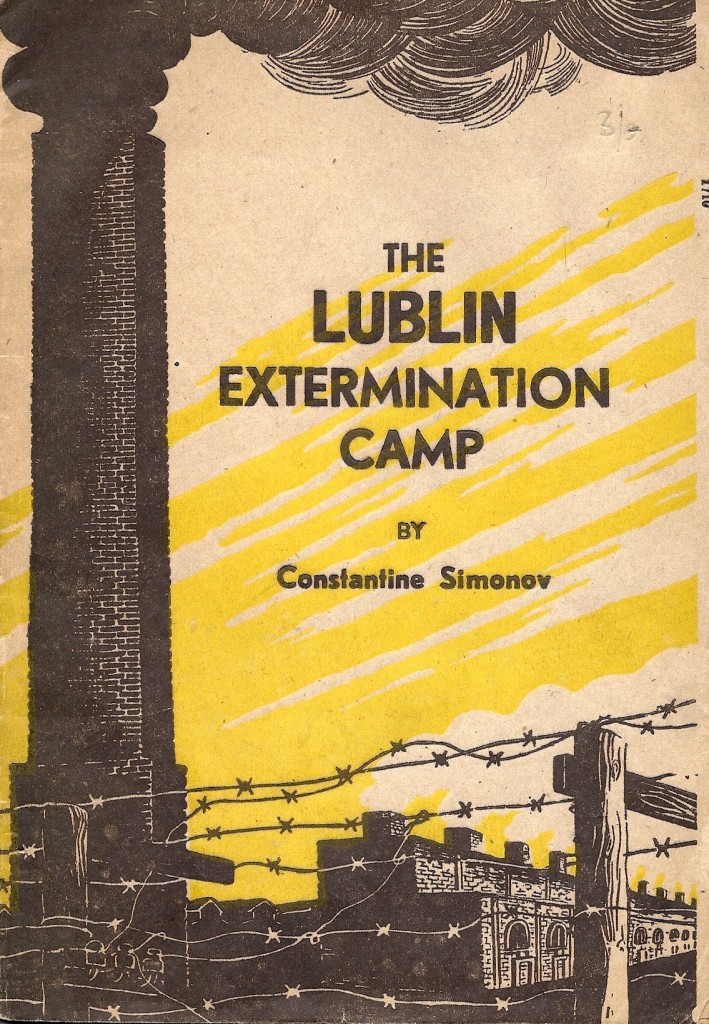
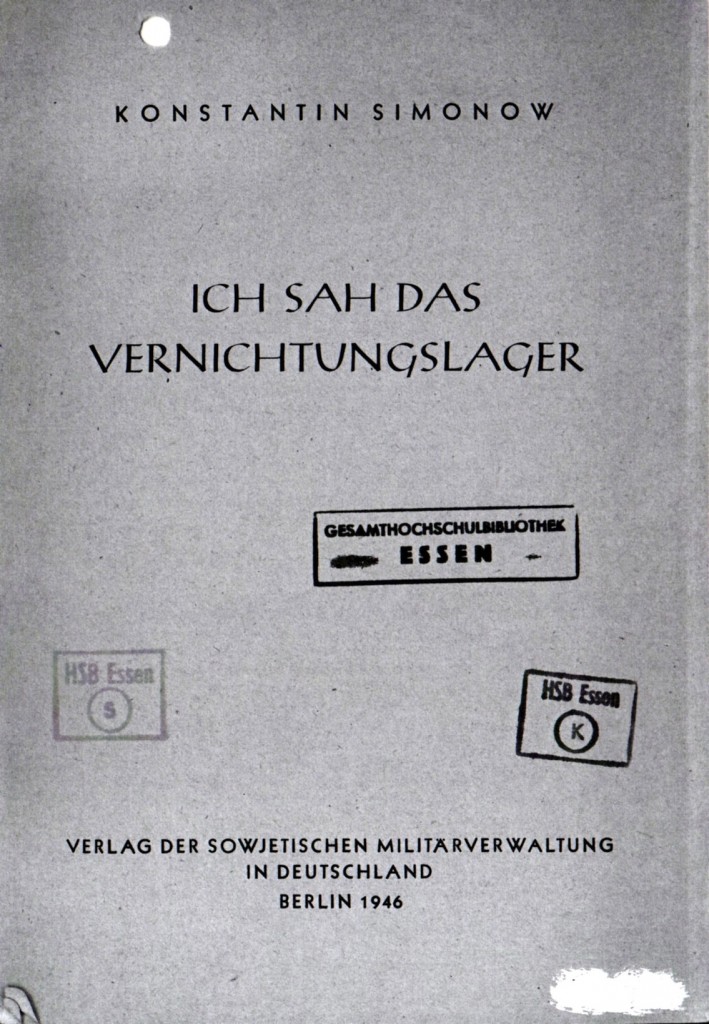
“Celan once remarked, that ‘Todesfuge’ arose from something he read about Jews playing dance tunes in a Nazi camp. He might have seen a pamphlet dated 29 August 1944, on ‘The Lublin Extermination Camp’ (Maidanek). In July 1944 the Red Army took Maidanek, and what they discovered was publicized worldwide, as propaganda. This pamphlet, issued by Moscow’s Foreign Languages Publishing House, appeared in various cities and languages. Written by Konstantin Simonov, it reports that tangos and fox-trots were played during camp functions, and it contains other details suggestive of ‘Todesfuge’.

scannen0590 bach575
CLICK ON THE FRONT COVERS TO DOWNLOAD PDF VERSIONS OF THE PAMPHLETS

The earliest notice of Celan’s poem may connect it to the Simonov pamphlet. ‘Todesfuge’ first appeared not in German but in Romanian (it was Celan’s first published poem and his first under the name “Celan”). In May 1947, the Bucharest magazine Contemporanul printed Petre Solomon’s translation, prefacing it with the note: ‘The poem whose translation we are publishing is built upon the evocation of a real fact. In Lublin, as in many other ‘Nazi death camps,’ one group of the condemned were forced to sing nostalgic songs while others dug graves.'”

Deathfugue – First Publication (Romanian)

Reasons enough for me to track Konstantin Simonov and – Eureka! – I succeeded to figure out, that Konstantin Simonov visited Czernowitz while touring the fronts in June 1944. His report, headlined “ONLY ONE-THIRD OF CZERNOWITZ’ 80,000 JEWS REMAIN ALIVE, RUSSIAN CORRESPONDENT REPORTS” was published by the Jewish Telegraphic Agency (JTA) on June 21, 1944:

IMG_2269

Is it to keen to assume a possible personal meeting between Paul Celan and Konstantin Simonov during his visit in June 1944? John Felstiner wrote:

“I’m grateful for your sharing the news of his visit, and yes, it’s certainly *possible* they met. But who can confirm it? […] If you look at the Preface of my Celan anthology (Norton), you’ll see he wrote to a Czernowitz exile friend in Russia on July 1st, ’44: ‘I’ve come to Kiev for two days…” So at least it appears he may have been in Czernowitz a week earlier. A bit later in my book I mention PC translating Simonov. What a story in the making!”

41VP9Q8JHNL

Just imagine how exciting it was for me, to get such an encouraging feedback! Provided that my guess is correct, we might have identified another small piece of the puzzle related to the genesis of Paul Celan’s “Todesfuge”! But who can confirm it? – Back to you, Czernowitzers!

A Sunken Treasure of Czernowitz

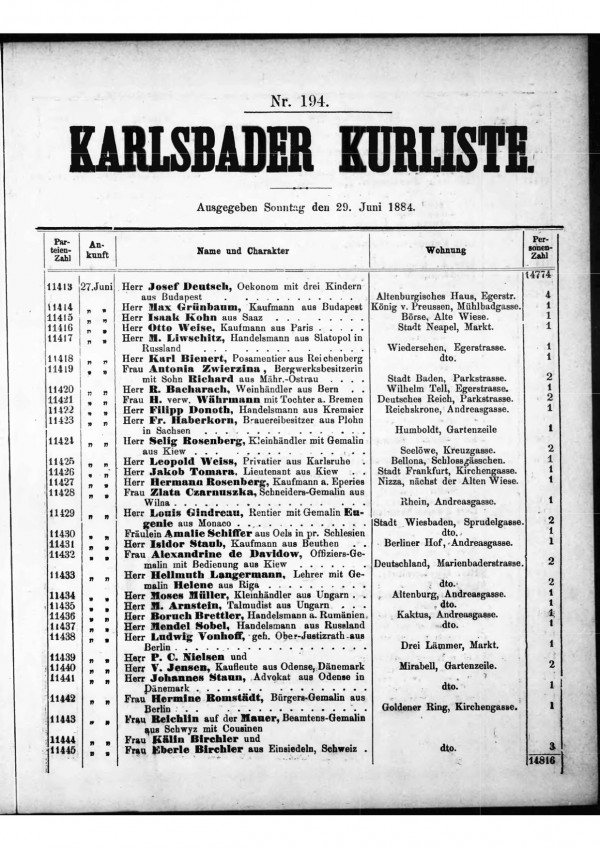
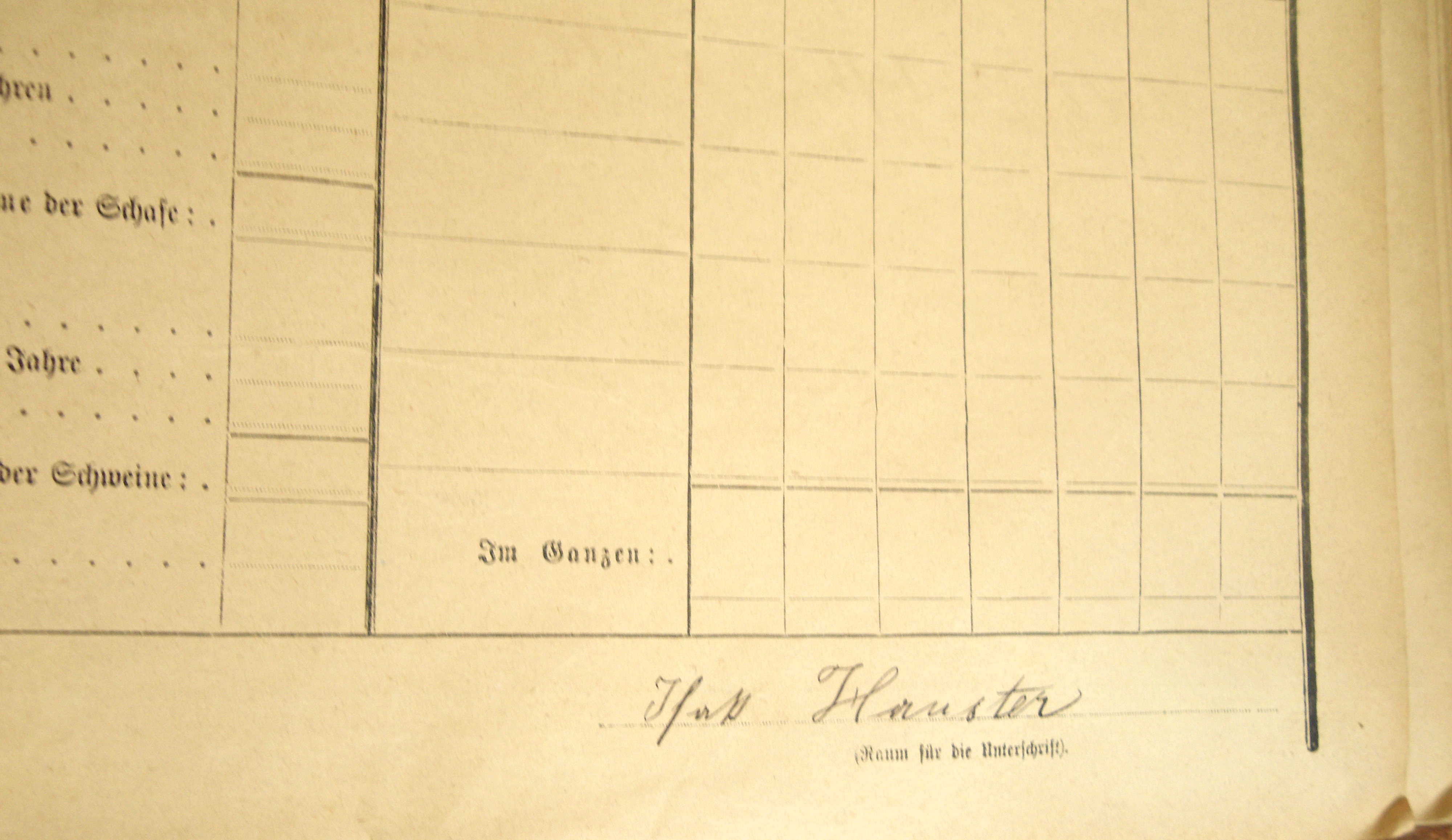
Dragoș Olaru (01.09.2012): “Nearly all primary data to the censuses effected for the CITY OF CZERNOWITZ during the Austrian period for the years 1869/70, 1880/81, 1890/91 and some of them for the year 1900 are deposited in our [Czernowitz Regional] Archives. I knew before about their existence, but thanks to Eli [Eliezer Schaffer] I examined several files and realized that these primary data are hiding a real treasure: the names of all persons registered house by house including the dates of birth, the localities where they came from coming to Czernowitz, their professions, the degree of relationship among themselves, etc. The first censuses were effected by house numbers, the last ones by streets [and house numbers…].”

IMG_2232

IMGP0413 Kopie 2

IMG_2233

Just a short seemingly trivial notice, but in fact A GENEALOGICAL BREAKTHROUGH, made possible by the priceless persistence of Eliezer Schaffer from Haifa and by the thoughtful cooperativeness of Dragoș Olaru. Just imagine, at the end of the day you will be able

• to track the migration movement for your family,
• to interchange house numbers with streets [+ house numbers], etc.

As a matter of fact, the census sheets provide even more information than the civil records, i. e.:
 
– names (surnames, forenames, titles [of nobility])
– relationship (degree of relationship to the occupant)
– sex
– dates of birth
– places of birth
– rights of residence (places of origin)
– religion
– civil status
– common language
– regular occupation (description, position)
– secondary occupation (description, position)
– houseowning, landowning
– literacy level (reading and writing, just reading, none)
– disabilities (blind, deaf-dumb, idiotic, cretin [!?])
– residence
– remarks

Carte de mester

From Catherine Herbst:

“Carte de mester” (1937) of my grandmother, Maria Nagelberg, wife of Emil Herbst. Her husband was a mathematics teacher in Czernowitz. Their children, my father, Gedeon (1909) and his brother Carol (1922) were born in Czenowitz.

I wonder what the proper English translation of ‘Carte de mester’ would be? What other information is on this card?

Catherine

click to enlarge photo
cartedemester1937a