Read more at:
“Monitorul de Suceava” (April 29, 2014)
History of the Solka Sanatorium by Dr. Joseph Poras (May 2006)
Solka: An Unlikely Story From A Place That Isn’t What It Used To Be by Iona (Jane) Rostos
“Die Stimme” article on Dr. Hermann Poras by Dr. Ferdinand Eisenhauer (February 1993)
Author Archives: Edgar Hauster

Three Schools in Czernowitz – Three Class Photos

Aron Pumnul Gymnasium in Czernowitz, Class VI B, Academic Year 1937-1938

Comenius Private School in Czernowitz, Class IV, Academic Year 1936-1937
All students were Jewish; at the left director Eusebiu Jemna, at the right form-master Isidor Mehler.

Gheorghe Tofan Elementary School in Czernowitz; in the middle director Eusebiu Jemna and a young student teacher.

A Shtetl in the Caribbean
Read more and contribute to the realization of the project at:
http://www.cinecrowd.nl/een-sjtetl-de-cariben?language=en
Mark Wiznitzer: “Language and culture are so intertwined. My father left Vascauti (Vashkivtsi, Vashkowitz) 40 km from Czernovitz in Bukovina in 1927.He attended cheder and did not have the opportunity to complete his education because he left Romania with his older brothers while in his mid-teens. But he eventually learned to do business in 7 languages, including Japanese. But Yiddish was his first language, in which he wrote to his brothers using Hebrew letters. My maternal grandmother, having finished gymnasium in Dresden where my mother was born, and her Polish-born university-educated husband, spoke German. But their other European languages came in handy as they had their other children in France and Belgium, and settled first in Colombia, and ultimately in Curaçao. To assimilate, my grandfather added “Montevenado” to his name, a Spanish translation of his surname. And so the name on his gravestone in the ancient Jewish cemetery Beit Haim Blenheim reads “Max Hirschberg Montevenado”. My mother, having received a Dutch education in Curaçao was fluent in several languages. But she did not learn Yiddish until she and my father made it through WWII in Japan, where they lived with my father’s cousin from Czernovitz and socialized with other Jews from Eastern Europe, as well as Iraq and Syria. When my parents returned to Curaçao in 1946, Yiddish came in handy as the language of the growing Ashkenazi community, which had reached a sufficient critical mass to resemble a “Shtetl”. In Curaçao we Ashkenzi Jews were callled “Polacos” because the first to arrive came from Polish Galicia, ironically from Snyatin, immediately across the Cheremosh river from, and the nearest town to, my father’s birthplace. My childhood classmate, Sherman de Jesus, lived near our community’s Shaarei Tsedek synagogue and social Club Union. He was fascinated by our community early on. A successful documentary producer and director, he is now completing a film project on the Shtetl in the Caribbean. At the link above, there is a clip of some scenes shot so far in Bukovina, Belarus and Israel.”
No “Silver Lining” on the Horizon Correspondence between Paul Celan and Jaap Geraedts

Czernowitz – Jewish City of German Language
 Click on the front cover for a – free – copy of Friedrich J. Ortwein’s book!
Friedrich J. Ortwein: “Up until now, I was profoundly convinced, that the love and the devotion of the citizens of Cologne to their home town, the antique CCAA (Colonia Claudia Ara Agrippinensium), one of the Daughters of Rome and free imperial city, cannot be exceeded by anybody in the world. But during the travel preparations for our journey to Galicia and Bukovina, when I came across the website of the Jews expelled from CZERNOWITZ, I had to reverse: The children and grandchildren of Czernowitzers, together with a few Holocaust survivors, have created a website containing a huge data volume and so they emphasize in an unique and inimitable way their love for the home country of their ancestors.
Forum members from all over the world, from the Americas, from Australia and South Africa, from Israel and Europe analyze, comment and swap ideas on events, research their genealogical roots, discuss and value rediscovered archival materials, enjoy old and new photos, exchange holiday and birthday wishes and all this happens in English with embedded German, Yiddish and Hebrew particles.”
Ambassador Mr. Dan Ben-Eliezer Visits the Temple in Radauti
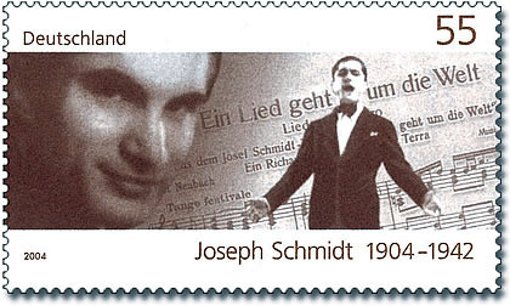
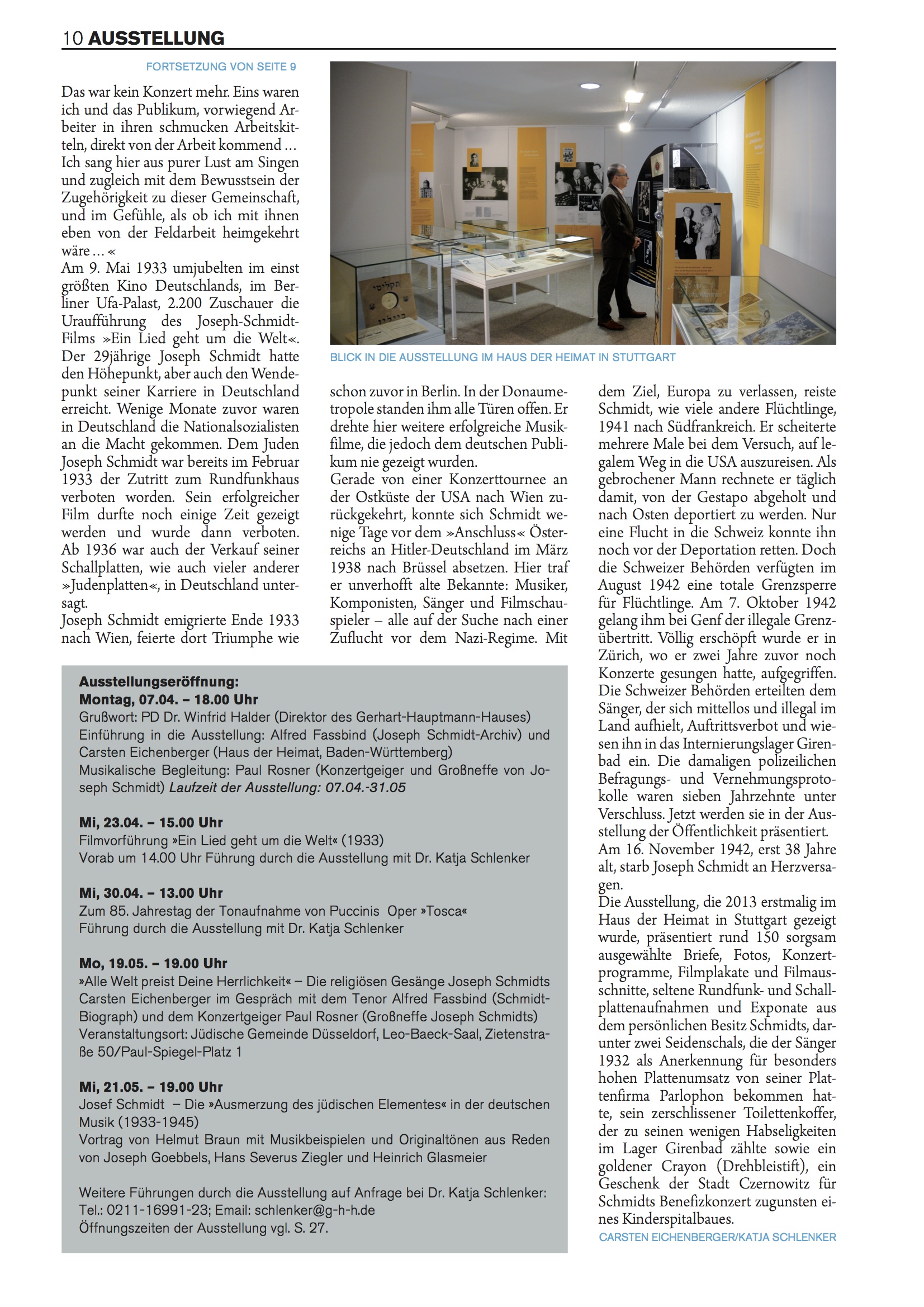
Joseph Schmidt – His Song Goes Round the World



New at the (German) Movies: “In Sarmatien” by Volker Koepp
Lipcani Jewish Cemetery Destroyed by Fire
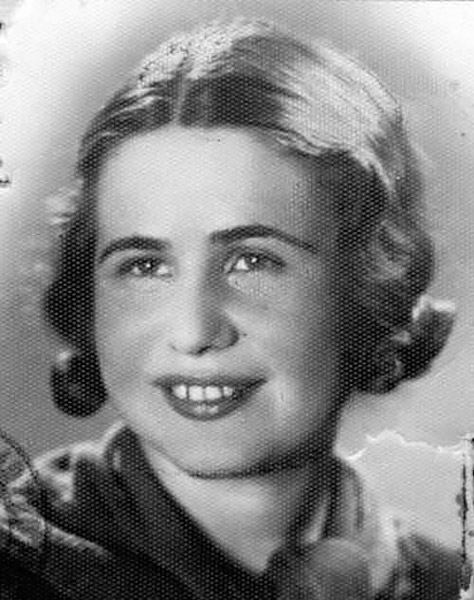
Irena Sendler, Social Worker, Humanitarian, Legend
Guest post by Laurie Rappeport, Safed/Israel: One of the biggest challenges that present-day Holocaust researchers face is the dwindling number of survivors who are still alive to bear testimony to their lives under Nazi rule. Many Holocaust memorials and museums, among them Yad Vashem, are working against the clock to collect testimonies and conduct research that can only be accomplished as long as first-person witnesses are accessible.
In addition to memorializing the victims these investigations are also frequently used to honor Righteous Gentiles — people who risked their lives to save Jews during WWII. Numerous archivists and researchers at Yad Vashem are trying to ascertain the needed information in order to acknowledge these individuals.
Sometimes, information about an episode or activity comes to light unexpectedly. Such was the case of Irena Sendler, a Polish woman who was honored by Yad Vashem in 1963 for her role in saving over 2500 Jewish children from the Warsaw ghetto. Sendler received one of Yad Vashem’s first Righteous Among the Nations honorariums but after she returned to Poland her story was forgotten. In 1999 however, a group of non-Jewish schoolgirls from Kansas, involved in a social studies assignment, heard a rumor about Sendler and decided to pursue the story. Thanks to these girls the incredible story of Irena Sendler’s wartime activities was publicized worldwide at the Milken Center .
Irena Sendler was an employee of the Warsaw Department of Welfare when the Germans invaded Poland in 1939. She became an active member of the Zagota underground — a resistance group which specialized in assisting Jews who were trying to escape from German persecution. In conjunction with Zagota Sendler helped Jews find hiding places and obtain false papers to enable them to hide. By 1940 Sendler was Zagota’s head of children’s services and she began to look for ways to help Jewish children escape from the Germans.
In 1940 the Germans built the Warsaw ghetto and imprisioned almost half a million Jews behind the ghetto walls without adequate food, shelter or medical care. Irena Sendler was able to obtain a pass that identified her as a nurse. She had free passage into and out of the ghetto and, at first, she used her pass to try and smuggle food and medicines into the ghetto. Sendler quickly saw that such efforts were like a drop in a bucket and she decided that, in order to help the largest number of people, she would have to find another course of action.
Sendler and the Zagota organization devised a plan which would allow her to smuggle children out of the ghetto. She began to pick children off the street — children whose parents had been murdered or simply disappeared. She sedated the children and smuggled them out of the ghetto by hiding them in toolboxes, luggage and in wagons under barking dogs and garbage. She found tunnels and sewers under the ground and, using those tunnels, was able to lead the older children to the “free” side of Warsaw.
Sendler’s next course of action involved speaking to parents and asking them to allow her to take their children out of the ghetto. In an interview that Sendler conducted in 2004 she described those experiences.”I talked the mothers out of their children. Those scenes over whether to give a child away were heart-rending. Sometimes, they wouldn’t give me the child. Their first question was, ‘What guarantee is there that the child will live?’ I said, ‘None. I don’t even know if I will get out of the ghetto alive today.” Many parents refused to allow Sendler to take their children. They held out hope that, by staying with their families, the children had the best chance of survival. Other parents were concerned that the children would not be able to survive among anti-Semetic Polish gentiles. Over the course of two years however, Sendler was able to smuggle over 2500 children out of the ghetto. She recorded their names and their hiding places on pieces of tissue paper and hid them in glass jars which she buried in her yard. Zagota found hiding places for the children in convents, orphanages and with sympathetic Polish families. Sendler was arrested after the fall of the Warsaw ghetto and sentenced her to be shot but Zagota was able to rescue her and she lived out the rest of the war in hiding. When the Kansas students began to research Sendler’s actions during the war, there was little information available, but Sendler herself was still alive. The girls obtained funding that allowed them to travel to Poland and interview Sendler. They then created a massive project, Life in a Jar, to honor Irena Sendler’s heroism and bravery.
Laurie Rappeport lives in Safed, Israel. She teaches Judaism and Israel-related subject via elearning to American day school and Hebrew school students.