Author Archives: Edgar Hauster

Three Poems by Klara Blum aka Zhu Bailan

Jung-Czernowitz

Da, wo die Gäßchen sich zusammenzogen,
Der Witz das eigne Unglück höhnte wild,
Wo sich der Armen Rücken keuchend bogen,
Die Not sie an den Schläfenlocken hielt-

Wo ich einst stand in tobenden Gedanken,
Die Stirne angepreßt dem Mauerstein,
Wirr, achtzehnjährig, doch schon ohne Wanken,
Entschlossen, mir zu folgen ganz allein-

Da steht nun, achtzehnjährig, eine zweite,
(Ich sah sie nie und seh sie dennoch gut.)
Ihr Auge überglänzt die freie Weite,
Der Weite Glanz auf ihrer Stirne ruht.

Schlank die Gestalt und stürmisch die Gebärde,
Die Brauen grüblerisch, gebräunt die Hand.
Aus ihrer Stimme tönt die Heimaterde,
Befreites, völkerbuntes Buchenland.

Du hörst darin der Doina Wohllaut klingen,
Treuherzig summt dazu ein Schwabenlied,
Es rauschen der Ukraine Sturmeschwingen,
Indes der Judenscharfsinn Funken sprüht.

Da, wo die Armen einst in Ghettogassen
Dem Brot nachspürten, listig, ängstlich-dreist,
Da greift sie heut zur Arbeit, stolz gelassen
Und ruhig, stolz entfaltet sich ihr Geist.

Wo im Kasino bunte Lichter lohten:
“Ihr seid zur Schmach bestimmt, drum haltet still”,
Wo mich der Heiratsmarkt einst feilgeboten,
Da wählt sie heut zum Gatten, wen sie will.

Die Buchen wiegen ihre Vogelnester,
Der frische Pruth die freie Stadt umfließt-
Gegrüßt sei, schöne unbekannte Schwester,
Du junges Czernowitz, sei mir gegrüßt.
793439-d9b0592d7beed2fa0150b2f32a55ea27

Czernowitzer Ghetto

I
Die alten Gäßchen ziehn sich eng zusammen.
Der Boden hinkt und holpert im Zickzack.
Aus schweren Leuchtern zucken kleine Flammen.
Der Witz treibt mit dem Unglück Schabernack.

Die Augen funkeln, doch die Wangen blassen,
Der Kaftan reißt, die Schläfenlocke bebt,
Wenn, halb erstickt in seinen Pariagassen,
Ein Volk noch stöhnend, höhnend weiterlebt.

Die Mauer fiel vor mehr als hundert Jahren,
Und dennoch blieben sie im dumpfen Nest.
Das Elend hielt sie an den Schläfenhaaren
In ihrem engen alten Ghetto fest.

II
Für manche schlug die Befreiungsstunde
– Sie waren einflußreich und satt und breit -,
Da lobten sie den Herrn aus vollem Munde
Und lobten ihre aufgeklärte Zeit.

Sie zogen vornehm in die Gartenstraßen
Zur Nachbarschaft mit Oberst und Bojar.
Man mißt sie nicht mit den gewohnten Maßen.
Sie sind “zwar” Juden, aber – annehmbar.

Bunt leuchtet abends der Kasinogarten,
Und die Kapelle spielt rumänisch heiß,
Blasiert betrachten sie die Speisekarten,
Sie sind ein lauter, selbstbewußter Kreis.

Es klingt ihr Deutsch zerdehnt, verfärbt, verbogen,
Geflickt mit Slawentrotz, Romanenglut,
Buntscheckig Narrendeutsch, von Leid durchzogen,
Vergessnem Leid, das fern im Ghetto ruht.

Die alte Klage dehnt noch ihre Sprache,
Pogrom und Schimpf und Wandern ohne Rast.
Doch längst vergaßen sie schon Groll und Rache,
Und der Feudalherr ist ihr lieber Gott.

Sie sitzen da, sie nehmen ihn zum Muster,
Ihr Stolz wird schwach, die Arroganz erstarkt,
Sie sind ein Kreis, ein lauter, selbstbewußter,
Sie sind ein schamlos lauter Heiratsmarkt.

Was soll ich tun? Kann ich den Lauf nicht ändern?
Mein vorbestimmter Gatte sitzt vor mir.
Und drüben, aus den dunklen Augenrändern,
Da starrt und starrt der blaue Offizier.

Man sagt ihm nach, er jagt nach leichten Freuden,
Man sagt, er kommt und sieht und spielt den Herrn,
Man sagt, er kann wohl keine Juden leiden,
Doch ihre Frauen, sagt man, nimmt er gern.

Die Fraun, die in den Gartenstraßen wohnen –
Leer ist ihr Leben, ein geputzter Zwang.
Sie girren laut, sie suchen Sensationen,
Wohin denn sonst mit ihrem Tatendrang?

Und die Musik spielt auf mit heißem Klingen
Und dringt betäubend in die Sinne ein,
Ich hab geträumt, einst Großes zu vollbringen,
Und so – und so wird nun mein Leben sein.

Zuerst gewiß der legitime Gatte
Und dann der Advokat, der kluge hier,
Und dann Papas Geschäftsfreund, dieser glatte,
Und dann – dann kommt der blaue Offizier.

Ich bin vom Tische plötzlich aufgesprungen
– Zum Glück gibt niemand in dem Lärmen acht -,
Ich renne, renne mit gehetzten Lungen,
Ich renne meine Antwort durch die Nacht.

III
Die halbe Stadt hab ich im Zorn durchlaufen.
Ich bin am Ziel. Gleichgültig scheint der Mond
Auf einen dunklen morschen Häuserhaufen,
Darin bedrückt, erstickt der Paria wohnt.

Die alten Gäßchen ziehn sich eng zusammen,
Der Boden hinkt und holpert im Zickzack:
Plebejerwiege, der wir doch entstammen,
Wir im Kasino, protzenhaftes Pack.

Was sind wir? Abklatsch von feudalen Puppen,
Hier aber ringt und grübelt und erkennt,
Genährt, gereizt von ihren Bettelsuppen,
Die Kraft, die einst die Welt ihr Eigen nennt.

Es schärft sich gut die Logik dem Genarrten,
Das Rechtsgefühl dem, der ein Unrecht litt.
Heiß brennt der Stolz des Menschen, den mit harten
Gespornten Stiefeln man zu Boden tritt.

Ich bin dein Kind, du alte Judengasse,
Und lern aus allem, was mein Volk erfährt.
Stark, wenn ich denke, stärker, wenn ich hasse,
Aus jeder Schwäche schmiede ich ein Schwert.

Lehr du mich, lehr, von hier mich loszuringen,
Mühsal zu tragen, Hunger, Krankheit, Leid
Und alle Fragen, alle zu bezwingen
Allein mit meiner wilden Redlichkeit.

An deine Mauer drück ich meine Stirne.
Von heute an gehorch ich mir allein.
Folg meiner Galle. Folge meinem Hirne.
So geh ich recht. Es kann nicht anders sein.

pbooooz

Der Wunderrabbi von Sadagura

Man raunt: er kann Geburt und Tod erzwingen,
Auf einem Tüchlein fährt er übers Meer,
Sein Lächeln wird dir Glücksgeschäfte bringen,
Sein Zornesblick macht deine Taschen leer.
Man geht zu ihm mit Klagen und Beschwerden,
Verlassne Fraun und Händler vorm Bankrott.
Es ist nicht leicht: von ihm empfangen werden.
“Ein andermal, der Rabbi spricht mit Gott.”

Sein Haus ist voll von altem, schwerem Prunke,
Der Sabbathleuchter glänzt vor Kostbarkeit,
Kunstvolle Becher neigen sich dem Trunke,
Und sein Gebet, es trägt ein seidnes Kleid.

Er lehnt am Fenster mit gefurchter Stirne.
Es zittert leise sein gepflegter Bart.
Er weiß: Nicht mehr gehorchen ihm die Hirne
Wie einst, durch seine bloße Gegenwart.

Sie gehn vorbei mit hohnverhaltnen Gesten,
Die Kränkung sticht, der fromme Rausch bleibt aus.
Er sieht nicht mehr wie einst in allen Ästen
Die Zeichen der Kabbala, alt und kraus.

Am Horizont, mit violetten Spitzen,
In wilder Schönheit die Karpathen ziehn.
Er weiß von Liedern und er weiß von Witzen,
So spricht man und so singt man über ihn.

Man sagt: tief kann er in die Zukunft schauen,
Ob wahr, ob falsch – bewundert seinen Blick!
Man singt: er heilt die kinderlosen Frauen,
Das tut er gern, das weist er nie zurück.

Es reckt sich hügelig die enge Gasse,
Ein Kind ruft Czernowitzer Blätter aus,
Dort drüben wohnt der Schuster Reb Menasse,
Das ist sein armes, morsches, kleines Haus.

Er hockt vertieft auf seinem Schemelsitze.
Er liest. Der Rabbi kneift die Augen ein.
Er weiß, der macht die allerschärfsten Witze.
Was für ein Buch mag da sein Buch wohl sein?

Ein dickes Buch. Er kaut die schweren Sätze.
Er kommt in Schwung. Er wiegt sich hin und her.
Er prüft und wendet die Gedankenschätze.
Er hat begriffen. Mehr und immer mehr.

Sein Daumen schwingt, der Logik froh, ins Leere.
Er beugt sein heißvergrübeltes Gesicht
Aufs Buch hinab, als ob’s der Talmud wäre.
Der Talmud, Rabbi, aber ist es nicht.

Bukovina Women’s Society in Tel Aviv

b2_216b1
Bukovina Women’s Society in Tel Aviv

First row, sitting from left to right: Lizzy Edelstein, Lola Körner, Mady Elefant,
Genia Albin (chairperson), Zunia Schifter (honorary president), Fanny Glasberg, Klara Blum.
Second row, sitting: (left) Sali Kula (secretary), (right) Hilde Katz.
Standing, from left to right: Lizzy Osterer, Gerda Berger, Rosa Rittberg, Fanchette Melzer,
Fanny Bernstein, Martha Kissmann, Dr. Rachelle Rinzler, Dr. Erich Neuborn, Lola Wildmann,
Dorit Wagner, Lodzia Besner, Tella Löbel and Lona Münzer

Fortunoff Video Archive for Holocaust Testimonies

banner

The Fortunoff Video Archive for Holocaust Testimonies is a collection of over 4,400 videotaped interviews with witnesses and survivors of the Holocaust. Part of Yale University’s department of Manuscripts and Archives, the archive is located at Sterling Memorial Library.

Professor Dr. Dori Laub was born in Czernowitz in 1937. With his parents, he was deported to Transnistria in 1942. His father disappeared during a German raid prior to liberation by the Soviets and he and his mother were reunited with his grandparents who had survived in Czernowitz. He immigrated to Israel in 1950 where he attended medical school. Today he is Associate Clinical Professor of Psychiatry at Yale University and a psychoanalyst in private practice. In 1979 he co-founded the Holocaust Survivors’ Film Project, Inc., which subsequently became the Fortunoff Video Archive for Holocaust Testimonies at Yale. Dori Laub has published and lectured extensively on the Holocaust.

laub_large

Bearing Witness to the Holocaust – How the First Video Archive of Holocaust Testimonies Was Established
“Tell Us What You See” – Interview with Professor Dori Laub by Yad Vashem

Managing Jewish Immovable Heritage

04:24 Marla Raucher Osborn: Impact of Jewish Genealogists
21:17 Cologne Jewish quarter excavations
42:01 Ilya Lensky (Latvia) – Developments with the restoration of the synagogue building in Kuldiga and the Green synagogue in Rezekne
63:26 Marcus Roberts (UK) – J-trails
80:02 Annie Sacerdoti: Whither the European Day of Jewish Culture

CLICH HERE FOR THE FULL JHE CONFERENCE COVERAGE
CLICK HERE FOR MARLA RAUCHER OSBORN’S PRESENTATION
CLICK HERE FOR THE PICTURES FOR MARLA RAUCHER OSBORN’S PRESENTATION
CLICK HERE FOR MARLA RAUCHER OSBORN’S ESSAY “WHAT REMAINS OF A LIFE”

Marla Raucher Osborn: “From April 23-25, 2013, I attended a conference at the Jewish Community Center in Krakow, Poland on Jewish heritage management. The conference was a follow up to an earlier seminar on Jewish heritage management in Bratislava, Slovakia in March 2009 by Jewish community representatives and experts from a dozen countries.

This year’s conference had approximately 90 participants from 20 different countries. The focus was on Jewish preservation projects, challenges, and strategic thinking, and also on how to unite « experts » in these fields with Jewish descendants groups who which to pursue, or who have, on-going preservation projects but lack the know-how, contacts, and funding to proceed and/or fulfill their goals. […] I am a « hybrid » – a « cross-over » – individual: a passionate genealogist AND preservationist.. I am not an expert on Jewish heritage preservation but I am an advocate for its place in the world of Jewish genealogy. I also know firsthand the discouragement that can set in when an individual or a group feels overwhelmed by projects too large, too expensive, and too far away to even start, let alone manage and see to completion.

All of us in the Rohatyn Shtetl Research are intimately familiar with these feelings.

Our group – the Rohatyn Shtetl Research Group (“RSRG”) – has numerous on-going Jewish heritage projects in Rohatyn, as you know, including a Jewish headstone recovery project which has grown in size and complexity over the last few years. The practical issues and financial considerations faced by us are typical of other Jewish descendants groups who seek to memorialize their town’s pre-War Jewish population and perhaps contemplate someday acquiring surviving buildings of former Jewish significance.

I strongly believe that the RSRG Jewish headstone recovery project could not have been possible without the support of the local (non- Jewish) Ukrainian community of Rohatyn of today. This issue – the involvement and support of the present-day community in the recovery and maintenance of Jewish heritage – was a recurrent theme among the presenters at this year’s conference. […]”

The Genesis of Paul Celan’s “Todesfuge”?

From the renowned biography “Paul Celan: Poet, Survivor, Jew” by John Felstiner, Professor Emeritus of English at Stanford University and author of many standard works on Paul Celan, we learn (p. 28) on the genesis of Paul Celan’s “Todesfuge” as follows:

41T0YA94NEL._SS500_

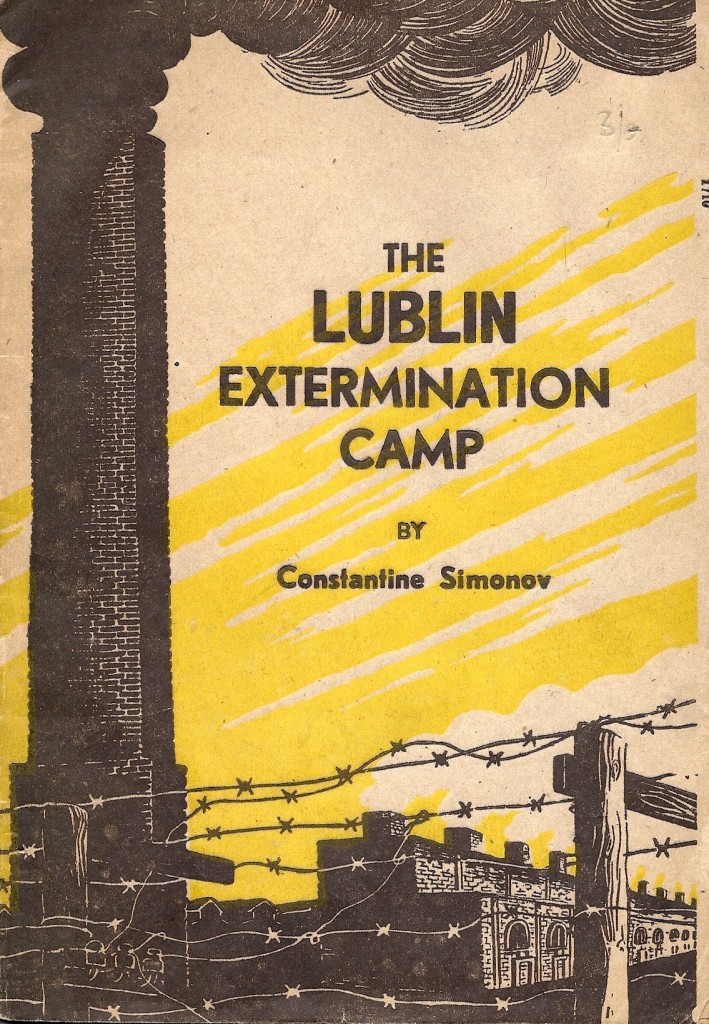
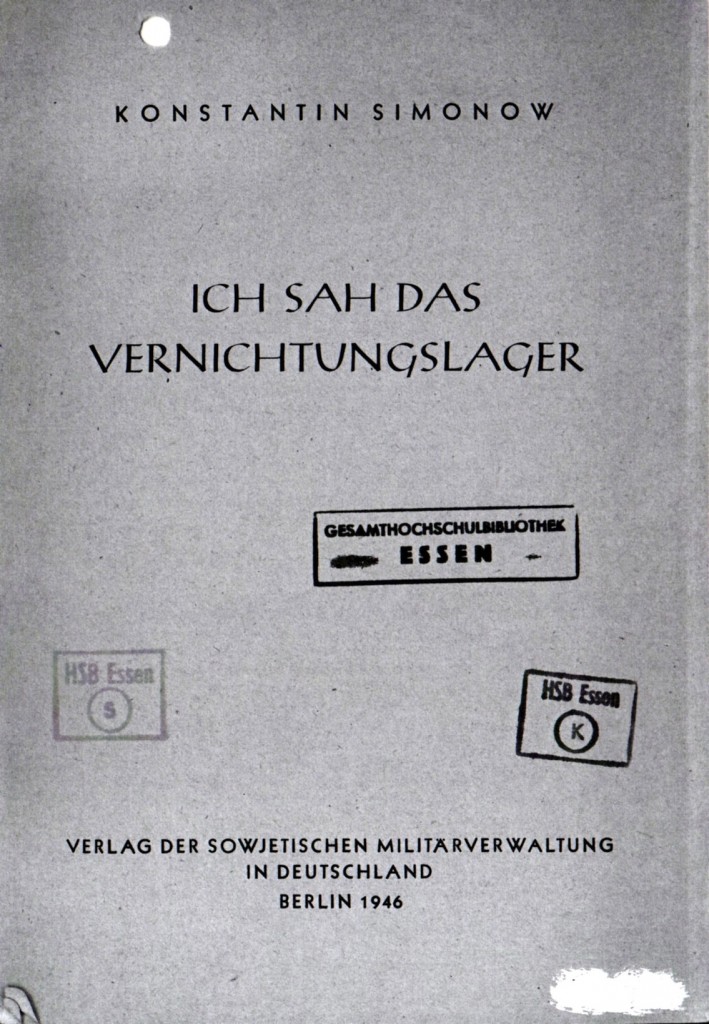
“Celan once remarked, that ‘Todesfuge’ arose from something he read about Jews playing dance tunes in a Nazi camp. He might have seen a pamphlet dated 29 August 1944, on ‘The Lublin Extermination Camp’ (Maidanek). In July 1944 the Red Army took Maidanek, and what they discovered was publicized worldwide, as propaganda. This pamphlet, issued by Moscow’s Foreign Languages Publishing House, appeared in various cities and languages. Written by Konstantin Simonov, it reports that tangos and fox-trots were played during camp functions, and it contains other details suggestive of ‘Todesfuge’.

scannen0590 bach575
CLICK ON THE FRONT COVERS TO DOWNLOAD PDF VERSIONS OF THE PAMPHLETS

The earliest notice of Celan’s poem may connect it to the Simonov pamphlet. ‘Todesfuge’ first appeared not in German but in Romanian (it was Celan’s first published poem and his first under the name “Celan”). In May 1947, the Bucharest magazine Contemporanul printed Petre Solomon’s translation, prefacing it with the note: ‘The poem whose translation we are publishing is built upon the evocation of a real fact. In Lublin, as in many other ‘Nazi death camps,’ one group of the condemned were forced to sing nostalgic songs while others dug graves.'”

Deathfugue – First Publication (Romanian)

Reasons enough for me to track Konstantin Simonov and – Eureka! – I succeeded to figure out, that Konstantin Simonov visited Czernowitz while touring the fronts in June 1944. His report, headlined “ONLY ONE-THIRD OF CZERNOWITZ’ 80,000 JEWS REMAIN ALIVE, RUSSIAN CORRESPONDENT REPORTS” was published by the Jewish Telegraphic Agency (JTA) on June 21, 1944:

IMG_2269

Is it to keen to assume a possible personal meeting between Paul Celan and Konstantin Simonov during his visit in June 1944? John Felstiner wrote:

“I’m grateful for your sharing the news of his visit, and yes, it’s certainly *possible* they met. But who can confirm it? […] If you look at the Preface of my Celan anthology (Norton), you’ll see he wrote to a Czernowitz exile friend in Russia on July 1st, ’44: ‘I’ve come to Kiev for two days…” So at least it appears he may have been in Czernowitz a week earlier. A bit later in my book I mention PC translating Simonov. What a story in the making!”

41VP9Q8JHNL

Just imagine how exciting it was for me, to get such an encouraging feedback! Provided that my guess is correct, we might have identified another small piece of the puzzle related to the genesis of Paul Celan’s “Todesfuge”! But who can confirm it? – Back to you, Czernowitzers!

Let your Eyes…

l002

Zwiegestalt 2006
Aloys Rump’s series of art works on Paul Celan

The blog post with the pictures of:

Synagogues of Khust, Shargorod, Bolekhiv, Palace of Tsadik Friedman of Ruzhyn in Sadhora (Czernowitz), Cemeteries of Bila Cerkva, Czernowitz, Medzhibozh, Bolekhiv

There it is, in so many places

ended with the citation of Paul Celan’s poem:

Lass dein Aug in der Kammer sein eine Kerze,
den Blick einen Docht,
lass mich blind genug sein,
ihn zu entzünden.

This was translated into English:

Let your eyes become a candle in the chamber,
your glance a canon,
let me become blind enough
to light it.

Some of our friends rightly protested against the use of canon instead wick of the German word Docht. When you take a look at the French version of the whole text including the poem (at the same site)

Il est, en tant de lieux

you will find the usual translation of Docht i.e. wick and not canon. Should one conclude that the translator into English was simply mistaken or that he thought to have a reason to change the word into another so different one? We don’t know from the site who the translator into English was, although the name of the author of the French translation is given. But ignoring the Docht the rest is very well done. So he might, and surely deserves to be given the credit to have had a reasonable purpose in using this poetical freedom in translation. The whole poem has 2 verses:

ZWIEGESTALT (about 1954)

Lass dein Aug in der Kammer sein eine Kerze,
den Blick einen Docht,
lass mich blind genug sein,
ihn zu entzünden.

Nein.
Lass anderes sein.

Tritt vor dein Haus,
schirr deinen scheckigen Traum an,
laß seine Hufe reden
zum Schnee, den du fortbliest
vom First meiner
Seele.

Zwiegestalt is a typical Celan creation of combining German words, zwei (two) and Gestalt, playing on the word Zwielicht which means so much as twilight. Should we translate it as Doubleshape or Twigestalt or Twishape into English?

The two shapes correspond of course to the two parts of the poem interrupted but also joined by the categorical:

No,
Let different be,

I won’t even try to translate the second part into English – no doubt that one reason it was not given here is the difficulty to render into another language the symbolism Celan creates in these lines in German. Another reason for not citing the whole poem is of course the relevance of the first part only of the poem to the pictures, the search for presence of those that are not anymore.

The main idea of the second part is to give an active alternative to the passive behavior of his interlocutor by demanding of him to implement his colorful dreams, have the strength of a horse and wipe away any sad thoughts. (Here I have to admit the guilt of free interpretation and may be some exaggeration). It remains an open question if the poem is about two persons, or at least connected to another addressed person, or is a pure monologue with himself, like a lot of other poetry by Celan and others.

Whatever the contrast between the two different verses of Celan’s poem is meant to represent, its features are of a strict personal intention. A reader may find many oppositions according to his own way of reading. Passive/active or pessimist/optimist or internal/external or subject/object or static/dynamic, there is so much to chose from these few lines that open a vast territory of psychology or even philosophy, that one could say that even for reasonable associations to the text the sky is the limit. But I can’t find any trace of an idea of murder, hate, repent, social injustice or collective indifference to the past. Indeed there is nothing “social” or “general” here in Celan that might connect to the pictures. Except may be blindness.

The first verse is cited because of the blindness of the people now living. If we accept that Celan is cited here not only with the intention to give a nice literary strong finish to an otherwise beautiful and sensitive report, then only the subject of blindness can be responsible for this inclusion. But what sort of blindness of the locals to the past atrocities to a former population of the region is here intended to be shown? Is it at random, contingent, or in principle, a quasi conscious effort to get away from that past so unpleasant or even difficult to live with? Are they just lost in the misery of their daily life that does not give them the time to look back, or are they denying on purpose the past of the region? Accidental or lawful behavior?

The translator votes for the last version and explicates it by the use of the word canon instead wick. True, any reader might associate by himself a wick to be the principal part of a candle without which all the burning and light giving would not take place. The wax being there only for sheltering and shielding it. But canon makes the connection stronger. It is both the guideline of ecclesiastical behavior and the meaning that was used by philosophers like Mills or Kant, of rule or principle of right thinking. It is not a matter of accidental choice, it is “the” choice you make as part of your reasoned behavior. We could say, not a matter of temperament but of character, of some people or of humanity as such. To take Celan out of context:

Has the world become blind enough for a sufficient time in order to light it? Can the question : “Where are you” be answered in any positive way? We know that somehow there must be a candle that might give light enough to see the truth of the canon but for the moment we can only feel it as a gaze that surrounds those lost places of Galicia or Bucovina, a gaze from the past that looks upon the present but can’t be seen.

Berti Glaubach