
Category Archives: Holocaust
Czernowitz Presentation by Christian Herrmann
Mr. Landmann, an Intellectual from Czernowitz!

Inscription: Landmann, intellectual from Czernowitz, 36 years old, died of hunger and cold on the road Moghilev – Scazinetz, 04.01.1942.
Artist: Erwin Schäfler, born in Vienna, left Austria for Romania in 1937, escaped to Ukraine in 1940, joined the Red Army, served on campaigns, returned to Transylvania in 1946, emigrated to Israel in 1958 and deceased in the year 1965.

In the Orphanage of Moghilev, March 1943

Atachi, November 1941
Links:
http://david.juden.at/kulturzeitschrift/66-70/66-Stephani.htm
http://collections.ushmm.org/search/catalog/bib37039
April/May 2011: Galicia & Bukovina – Twelve Slide Shows
Please click here for additional eleven slide shows or use the following link:
http://hauster.blogspot.com/2011/07/aprilmay-2011-galicia-bukovina-12-slide.html
Czernowitz Ghetto of 1941

Victory Day in Stanislau (Ivano-Frankivsk)
Please click here for additional pictures!
Happy Birthday, Alfred Schreyer!
This is Alfred Schreyer, born on 08.05.1922 in Drohobycz. Alfred Schreyer, who lost both his parents – his father was a chemist, his mother a pharmacist – to the Nazis and was himself at the camps Plaszów, Groß-Rosen and Buchenwald, is the only Jewish survivor still in Drohobycz who lived there during the occupation.
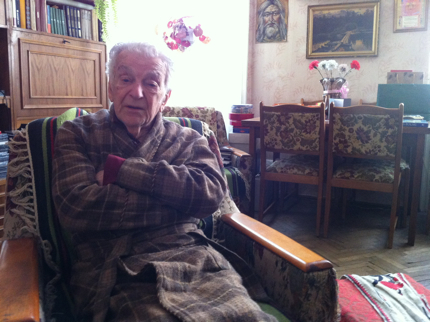
Most of the Jews from Drohobycz were murdered in the extermination camp Belzec, as Alfred Schreyer’s father, his uncle, his grandmother and an aunt. But 11,000 of them, among of them his mother, were also shot in the forest of Bronica, outside of town on the road to Sambor.

Drohobycz is a small town in the Austro-Hungarian province of Galicia. Located in the N.E. Carpathian foothills in the east Galician oil region, economically and culturally diversified, Drohobycz was one of the most significant centers of Jewish culture in Europe preceding WW2. And now?


Alfred Schreyer was a student of Bruno Schulz, the world-renowned writer and painter and a Polish Jew, who experienced the terror of German occupation in the Galician city of Drohobycz in 1941-42. He initially survived by painting murals for the children of the SS officer Felix Landau, on the nursery walls of the villa they had occupied. Bruno Schulz was shot and killed by the SS on November 19, 1942. Despite an intensive search after WWII, his murals were not found until February 9, 2001, when the documentary filmmaker Benjamin Geissler discovered the long lost pictures. In May 2001, representatives of Jerusalem’s Yad Vashem Holocaust Memorial removed fragments of these murals from Ukraine, sparking an international controversy.

On November 19, 1942, the great Polish author Bruno Schulz left his home in the Jewish ghetto of Drohobycz – according to the generally accepted version of the story, he had gone to fetch a ration of bread – and was shot to death by a German SS officer. The author of two critically acclaimed short-story collections and a graphic artist of growing renown, Schulz had survived the Nazi occupation as long as he did under the protection of Felix Landau, a vicious Gestapo officer who fancied himself a patron of the arts…Click here to read the full thrilling story, edited by Benjamin Paloff for the Boston Review!

Im Gespräch: Alfred Schreyer. Wie haben Sie den Krieg überlebt, Herr Schreyer? Sobald das Scheinwerferlicht angeht, vergisst Alfred Schreyer sein Alter. Fast sein gesamtes Leben hat der achtundachtzigjährige Opernsänger an ein- und demselben Ort verbracht – und dabei in fünf Staaten gelebt….Click here for the outstanding interview with Alfred Schreyer, conducted by Helga Hirsch for the FAZ!
Nazi Boycott of Jewish Businesses
Kyseliv – Borivtsi – Verenchanka
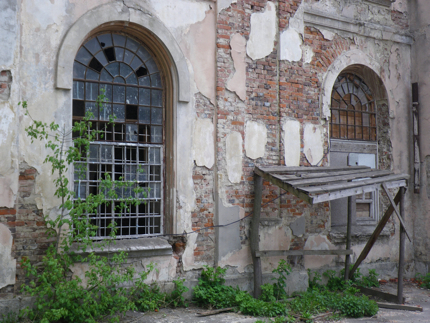
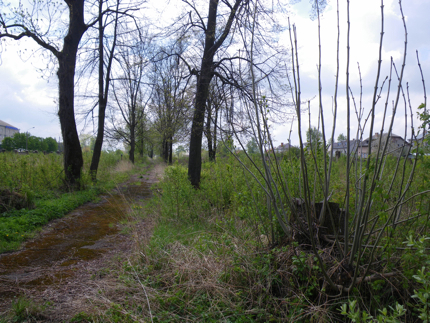
Pawel Otulakowski wrote to us: “Hello! I am Polish man who travelled to Ukraina to find family roots. Some of them are in Kyseliv. This is what I find near the village – monument without inscriptions (photo). I heard from local people history of this tragedy. Germans takes all jewish people from two twin villages – Kyseliv and Borivtsi (Kisielów i Borowce). They find also few Ukrainians who for promise to take all goods from victims agree to shot them. But they were usual people who don’t know how to kill. So they shoted even few times and they don’t kill some persons. Germans look for this and have fun that ukrainians do that “unprofessionally” . Died and alived – all were throwed to the little water eye that was deep in this time. There were corn around and few people saw everything. Everybody knows who were murderer but they lived without any consequences. Now they are die. I think You have to know about this and hope that monument will be repaired. There is also few macevas/gravestones in Verenchanka (Werenczanka) cemetery (photo).”


First I thought it is off-topic and off-area, but on closer examination I learned, that it is at least not off-area, as Kyseliv, Borivtsi and Verenchanka belong to the Czernowitz region and the Kitsman district. Above all, it can’t be off-topic, as similar brutal massacres happened in the whole area and – as Jerome mentioned – “it is one of those horrible, believable stories that is crying out to be heard, regardless of where it took place.”
Edgar Hauster
