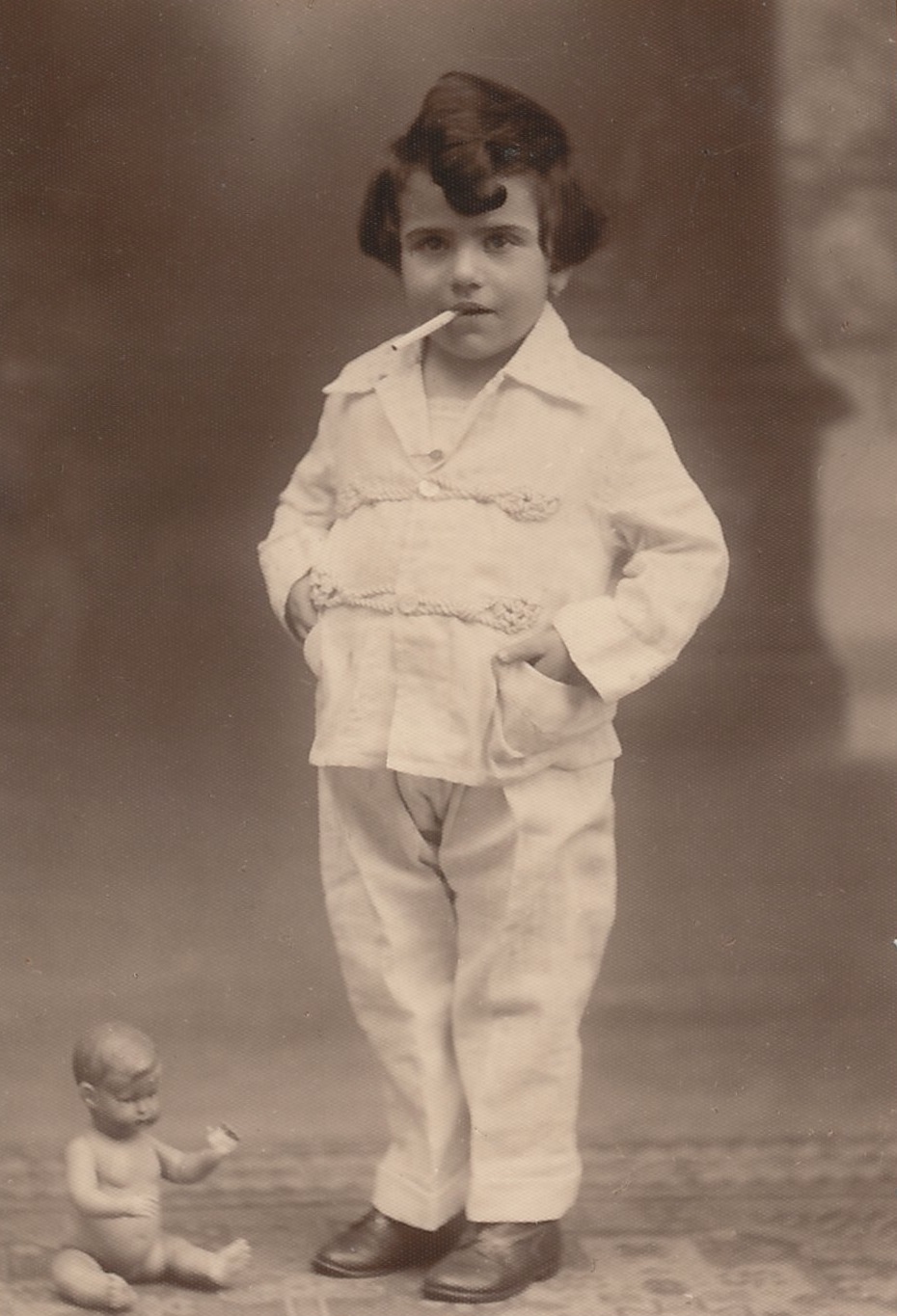
Iosif Vaisman: “A boy (or a girl?) in pajamas with a cigarette reading Czernowitzer Allgemeine Zeitung. May be somebody can recognize this child. […] Without trying to read too much into it, one can’t fail to notice several reveaing details. Most boys would pose as a sailor, a cowboy or something similarly “romantic” for a picture like this, this boy poses as a businessman (if a somewhat cartoonish one). Definite signs of the upper-class background: long and well cared for hair, starched and pressed pajamas, and, interestingly, Czernowitzer Allgemeine Zeitung – the more exclusive of two major German papers in Czernowitz (the other one – Czernowitzer Morgenblatt – was more “democratic”). But the most interesting part is the look on his face, very businesslike and cynical. The boy was a good actor.”
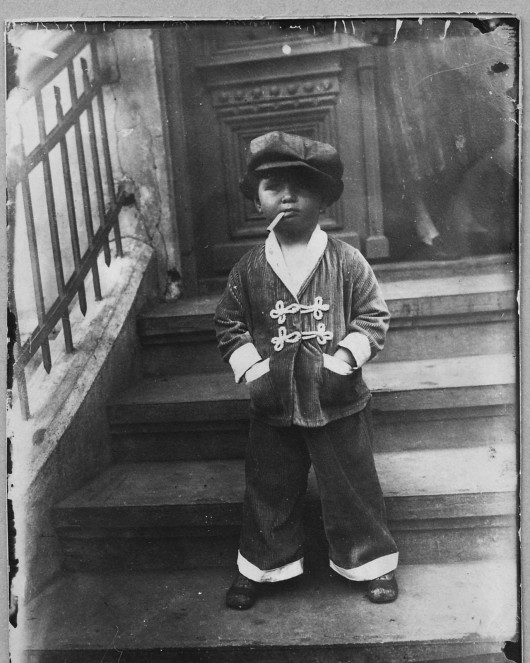 Victoria Gedaly, Römerbad, Czernowitz 1927
Ilana Gordon: “I was so surprised to see this picture. My mother has a similar picture that was staged at home. My great grandfather took my grandmother to America and left my mother at home. When they came back they saw my mother standing in front of their door. She was 3 years old, dressed like a man, with a cigarette in her mouth. This must have been some funny trend. When they came saw her, my great grandmother instructed her to say, (of course it was in German but I don’t know how to say it) “See what happens when you leave little children home!”
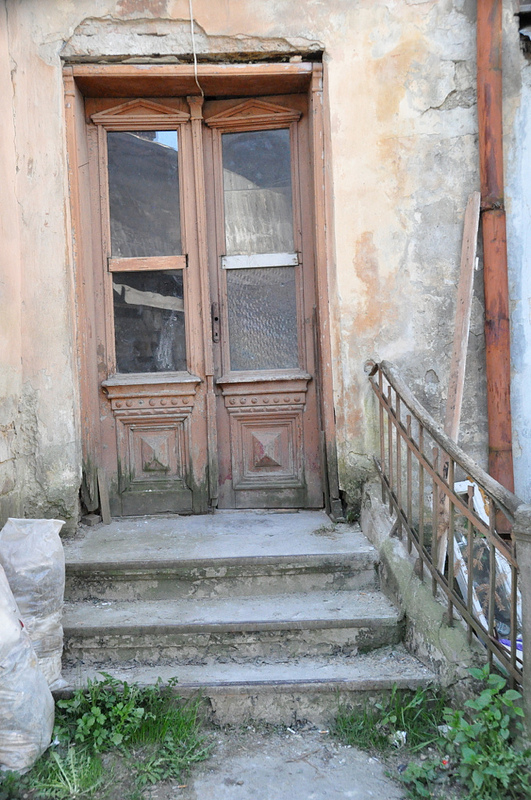
The interesting thing about this photo is that when I went to Czernowitz and found the Roemerbad we went into the courtyard and I immediately recognized the doorway and stairs that were exactly the same as they were in the photo.
Sylvia Segenreich: Das ist mein Bruder Theo [Theobald Engler] im Alter von fünf Jahren. Vielleicht war das anläßlich einer Purimfeier [1928]. Er ist so lausbübisch gestanden, ich weiß nicht warum. Ich war noch gar nicht auf der Welt, als das Foto gemacht wurde. Theo hat seit seinem 10. Lebensjahr bei der Maccabi Fußball gespielt. Er hat oft meinen Eltern nach der Schule bei ihrer Arbeit geholfen, und zweimal in der Woche mit einem Lehrer Religion und Hebräisch gelernt. Mit 13 Jahren hatte er seine Bar Mitzwa. Er ist aufs Gymnasium gegangen und hatte viele Freunde. Als er 15 Jahre alt war, wollte er, wie einige seiner Sportfreunde von der Maccabi nach Palästina auswandern, denn es war das Jahr 1938. Aber mein Vater wollte ihn nicht gehen lassen, er war noch so jung. 1941 wurde er von den Deutschen in Czernowitz erschossen. Da war er gerade 18 Jahre alt. [Source: centropa.org]
 Theobald Engler, Czernowitz 1928
Yvette Pintar: My great grandmother, Rosa Berl, daughter of Abraham Engler and Chaje Berl, was born in Czernowitz in 1889. I have finally decided to write (to you) after seeing the various photos of children with cigarettes, which *immediately* got my attention when the first one was posted on your website. My great grandmother had a brother named Osias Engler (I think his name was changed from Berl to Engler) whose daughter Sidonie was born in Czernowitz in 1926. I am fairly certain that this is a photo of Sidonie Engler, and it was likely to have been taking somewhere around 1930, guessing from her age in the photo. I have often thought of posting to the group, as I wonder if anyone knew my family there. I think Osias Engler left with his wife Rivka and daughter Sidonie around 1948, after the war. I have no idea what happened to them or where they ended up after 1948. My great grandmother had already left many years earlier and had moved to Leipzig (she left Germany and emigrated to South America in 1946). But I just had to share this photo with you as it clearly belongs with the others. You are welcome to post it if you would like.
 Sidonie Engler, Czernowitz ≈ 1930