Category Archives: Holocaust

LES ARPENTEURS – Le tourisme de la mémoire

LES ARPENTEURS : LE TOURISME DE LA MÉMOIRE

Dans les rues de Tchernivtsi, en Ukraine, Sylvie une jeune retraitée française, cherche l’ancien atelier de son oncle tailleur. Sa famille a perdu sa trace en 1941. À Lviv, autre ville ukrainienne, c’est Antonin, étudiant de 22 ans, qui entame avec sa grand-tante un périple émouvant dans son histoire familiale. Eux aussi sont à la recherche d’un aïeul disparu. Quant à Orane et Rémi, frère et sœur d’une trentaine d’années, c’est la Pologne qu’ils sillonnent, enquêtant sur la disparition de leur grand-oncle Léon.

Chaque année, de nombreux Français consacrent leurs vacances à tenter de retracer le destin de leurs ancêtres juifs. Ces derniers vivaient en Europe Centrale où des familles entières ont été les victimes de ce que les historiens appellent la « Shoah par balles ». Ainsi, en Ukraine, plus d’un million de Juifs ont été fusillés par les Nazis.

Ces touristes de la Mémoire portent un nom : les Arpenteurs. Ils sont aidés par des guides locaux qui préparent leur voyage, collectent indices et documents d’archives, repèrent les lieux ou retrouvent des personnes qui ont pu connaître leurs parents disparus. Un long travail fait de patience et d’obstination qui permet, parfois, de renouer les fils d’une histoire familiale souvent tragique.

Un reportage en forme de témoignage signé Renaud Lavergne et Vincent Barral

Berezhany: My City, My Pride

In Berezhany, a town in the Ternopil region of Western Ukraine, a group of local students discover their history.

Jeremy Borovits: First off, thank you for your responses, and for watching the film. It has been interesting for me to hear all of your thoughts about the topic.

My first point is this: In no way, shape, or form was my goal to exculpate Ukrainian participation in the Holocaust. I have been living in this country for three and a half years, and I am well aware of the role some Ukrainians played. The goal was to try and get the students to realize that the history of what happened in Berezhany is a part of their history, whether it happened to Jews, Ukrainians, Poles, Roma, or Armenians.

Judaism, as well as the Holocaust, is not taught very well in Ukraine. A part of this is certainly due to the role many Ukrainians play. But it is much more attributable to the fact that the Ukrainian education system is rife with corruption and is still based on the old Soviet model. All history taught in Ukraine is either Soviet-centric, Russo-centric, or Ukrainian-centric. This is a problem with how they approach history, not some deep rooted evil that lies within them.

Along that note, I have lived in Ukraine for three and a half years, and at least one conclusion I have come to is this: NOT ALL UKRAINIANS ARE ANTI SEMITIC. Are there anti-semites here? Yes, certainly. But in the time I have been here, I have never experienced any active anti-Semitism. This past Shabbat I was in New Jersey, and while walking home from synagogue someone yelled “Kike” at me from their car. And this was in New Jersey.

There were Ukrainians who participated in massacres during the war. There was a very small minority who risked their lives to save Jews. But the VAST majority was simply trying to survive. Their lives and the lives of their families were at risk. To hold all Ukrainians responsible for what happened is both historically inaccurate and morally wrong. In 1932-1933, Stalin exacted a famine on the Ukrainian people (as wel as some other nationalities.) Millions of people were starved to death (probably around 3 million). Lazar Kaganovich, a Jew, was one of the Soviet officials who executed the famine. To hold all Ukrainians as responsible for the Holocaust is to say that all Jews were responsible for the Holodomor (the name given to the famine.)

History is not, and will never be, black and white. We all have our own emotions that factor into the equation, the memories handed to us by our parents and grandparents and beyond. The challenge for all of us, and especially in projects like this, is to see the Grey.

No one had ever talked to these students before about Jews. They knew nothing. And now they know something. And they for sure, throughout the course of the project, got to know many Jews of various sizes, religious observance, and facial hair. I cannot guarantee that they have all changed. But I do get the sense that the next time someone says something about the Jews, these kids will stand up.

One last point to make: I am sure that all of you who have seen the film remember the man with the large mustache and the hat who spoke of the Jews drinking the Ukrainian’s blood. What didn’t make it into the final cut was the students arguing with him. How can you think that, they asked. How can you believe that? How can you not see that a person is a person.

I truly believe that hatred will breed hatred, and love will breed love. Teaching our children that we are all equal, that we are all individuals, and that every human life is sacred, is, for me, the best weapon against hatred, the best support for love.

This is a difficult topic, and the making of this film was a difficult process. I am sure some of will accuse me of naivety, or blindness, or perhaps of being a self-hating Jew. I can only tell you that it was while living in a Ukrainian village that I found Hashem, and my neighbors and students were there to support me.

If you have a response I welcome it, both via the forum as well as privately, if it makes you more comfortable.

All the best

Jeremy
Fortunoff Video Archive for Holocaust Testimonies

banner

The Fortunoff Video Archive for Holocaust Testimonies is a collection of over 4,400 videotaped interviews with witnesses and survivors of the Holocaust. Part of Yale University’s department of Manuscripts and Archives, the archive is located at Sterling Memorial Library.

Professor Dr. Dori Laub was born in Czernowitz in 1937. With his parents, he was deported to Transnistria in 1942. His father disappeared during a German raid prior to liberation by the Soviets and he and his mother were reunited with his grandparents who had survived in Czernowitz. He immigrated to Israel in 1950 where he attended medical school. Today he is Associate Clinical Professor of Psychiatry at Yale University and a psychoanalyst in private practice. In 1979 he co-founded the Holocaust Survivors’ Film Project, Inc., which subsequently became the Fortunoff Video Archive for Holocaust Testimonies at Yale. Dori Laub has published and lectured extensively on the Holocaust.

laub_large

Bearing Witness to the Holocaust – How the First Video Archive of Holocaust Testimonies Was Established
“Tell Us What You See” – Interview with Professor Dori Laub by Yad Vashem

Managing Jewish Immovable Heritage

04:24 Marla Raucher Osborn: Impact of Jewish Genealogists
21:17 Cologne Jewish quarter excavations
42:01 Ilya Lensky (Latvia) – Developments with the restoration of the synagogue building in Kuldiga and the Green synagogue in Rezekne
63:26 Marcus Roberts (UK) – J-trails
80:02 Annie Sacerdoti: Whither the European Day of Jewish Culture

CLICH HERE FOR THE FULL JHE CONFERENCE COVERAGE
CLICK HERE FOR MARLA RAUCHER OSBORN’S PRESENTATION
CLICK HERE FOR THE PICTURES FOR MARLA RAUCHER OSBORN’S PRESENTATION
CLICK HERE FOR MARLA RAUCHER OSBORN’S ESSAY “WHAT REMAINS OF A LIFE”

Marla Raucher Osborn: “From April 23-25, 2013, I attended a conference at the Jewish Community Center in Krakow, Poland on Jewish heritage management. The conference was a follow up to an earlier seminar on Jewish heritage management in Bratislava, Slovakia in March 2009 by Jewish community representatives and experts from a dozen countries.

This year’s conference had approximately 90 participants from 20 different countries. The focus was on Jewish preservation projects, challenges, and strategic thinking, and also on how to unite « experts » in these fields with Jewish descendants groups who which to pursue, or who have, on-going preservation projects but lack the know-how, contacts, and funding to proceed and/or fulfill their goals. […] I am a « hybrid » – a « cross-over » – individual: a passionate genealogist AND preservationist.. I am not an expert on Jewish heritage preservation but I am an advocate for its place in the world of Jewish genealogy. I also know firsthand the discouragement that can set in when an individual or a group feels overwhelmed by projects too large, too expensive, and too far away to even start, let alone manage and see to completion.

All of us in the Rohatyn Shtetl Research are intimately familiar with these feelings.

Our group – the Rohatyn Shtetl Research Group (“RSRG”) – has numerous on-going Jewish heritage projects in Rohatyn, as you know, including a Jewish headstone recovery project which has grown in size and complexity over the last few years. The practical issues and financial considerations faced by us are typical of other Jewish descendants groups who seek to memorialize their town’s pre-War Jewish population and perhaps contemplate someday acquiring surviving buildings of former Jewish significance.

I strongly believe that the RSRG Jewish headstone recovery project could not have been possible without the support of the local (non- Jewish) Ukrainian community of Rohatyn of today. This issue – the involvement and support of the present-day community in the recovery and maintenance of Jewish heritage – was a recurrent theme among the presenters at this year’s conference. […]”

The Genesis of Paul Celan’s “Todesfuge”?

From the renowned biography “Paul Celan: Poet, Survivor, Jew” by John Felstiner, Professor Emeritus of English at Stanford University and author of many standard works on Paul Celan, we learn (p. 28) on the genesis of Paul Celan’s “Todesfuge” as follows:

41T0YA94NEL._SS500_

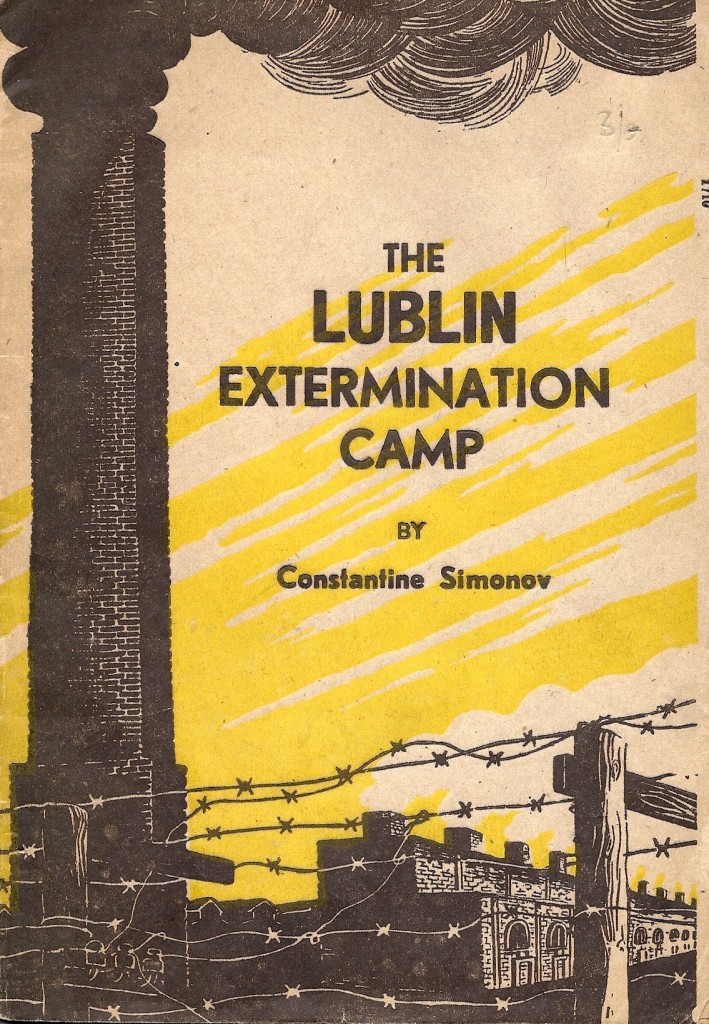
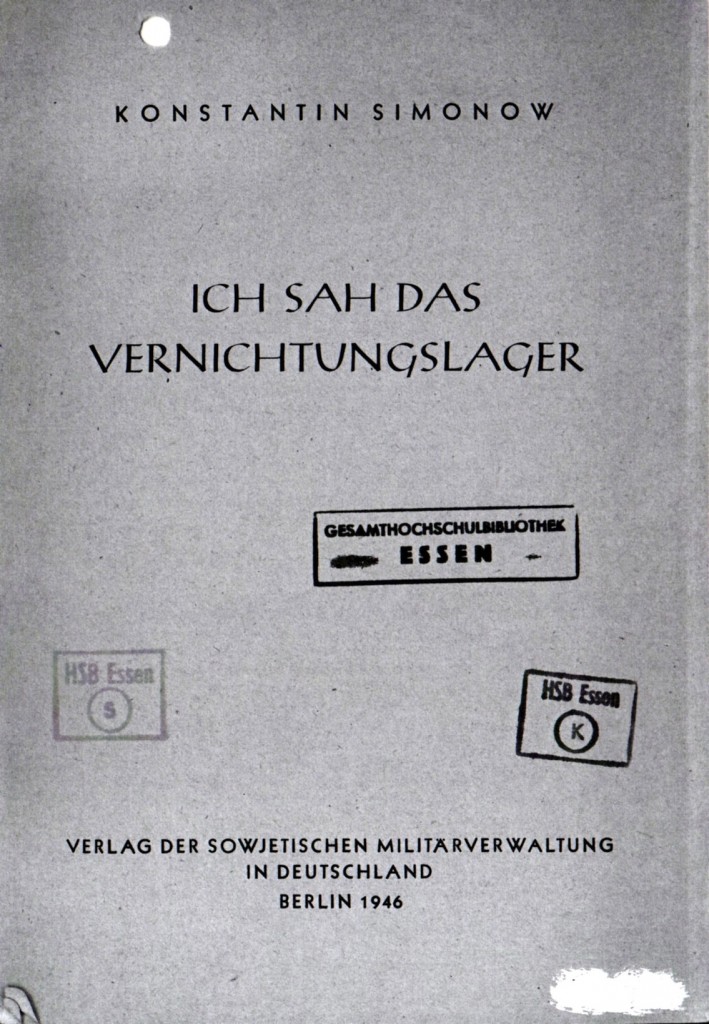
“Celan once remarked, that ‘Todesfuge’ arose from something he read about Jews playing dance tunes in a Nazi camp. He might have seen a pamphlet dated 29 August 1944, on ‘The Lublin Extermination Camp’ (Maidanek). In July 1944 the Red Army took Maidanek, and what they discovered was publicized worldwide, as propaganda. This pamphlet, issued by Moscow’s Foreign Languages Publishing House, appeared in various cities and languages. Written by Konstantin Simonov, it reports that tangos and fox-trots were played during camp functions, and it contains other details suggestive of ‘Todesfuge’.

scannen0590 bach575
CLICK ON THE FRONT COVERS TO DOWNLOAD PDF VERSIONS OF THE PAMPHLETS

The earliest notice of Celan’s poem may connect it to the Simonov pamphlet. ‘Todesfuge’ first appeared not in German but in Romanian (it was Celan’s first published poem and his first under the name “Celan”). In May 1947, the Bucharest magazine Contemporanul printed Petre Solomon’s translation, prefacing it with the note: ‘The poem whose translation we are publishing is built upon the evocation of a real fact. In Lublin, as in many other ‘Nazi death camps,’ one group of the condemned were forced to sing nostalgic songs while others dug graves.'”

Deathfugue – First Publication (Romanian)

Reasons enough for me to track Konstantin Simonov and – Eureka! – I succeeded to figure out, that Konstantin Simonov visited Czernowitz while touring the fronts in June 1944. His report, headlined “ONLY ONE-THIRD OF CZERNOWITZ’ 80,000 JEWS REMAIN ALIVE, RUSSIAN CORRESPONDENT REPORTS” was published by the Jewish Telegraphic Agency (JTA) on June 21, 1944:

IMG_2269

Is it to keen to assume a possible personal meeting between Paul Celan and Konstantin Simonov during his visit in June 1944? John Felstiner wrote:

“I’m grateful for your sharing the news of his visit, and yes, it’s certainly *possible* they met. But who can confirm it? […] If you look at the Preface of my Celan anthology (Norton), you’ll see he wrote to a Czernowitz exile friend in Russia on July 1st, ’44: ‘I’ve come to Kiev for two days…” So at least it appears he may have been in Czernowitz a week earlier. A bit later in my book I mention PC translating Simonov. What a story in the making!”

41VP9Q8JHNL

Just imagine how exciting it was for me, to get such an encouraging feedback! Provided that my guess is correct, we might have identified another small piece of the puzzle related to the genesis of Paul Celan’s “Todesfuge”! But who can confirm it? – Back to you, Czernowitzers!

“Transnistria” by Aurel Baranga (Aurel Leibovici) • 1913-1979

11442.1973.10.pag014-pag015

Transnistria

Dacă toate frunzele pamântului s-ar face hîrtie, dacă toate mările s-ar preface
în cerneala, dacă toate pădurile s-ar preface în condee, dacă toate
viețuitoarele ar scrie îndeajuns… Scriu despre supraviețuitorii de la
Vapniarca [Transnistria] și aș vrea ca fiecare literă să ardă, sa arda ca ochii
lor rătăciți, ca fețele lor devastate, ca mîinile tremurînde, ca pașii lor
triști, paralitici, ca trupurile lor înconvoiate și frînte.

Transnistria

If all the leaves on earth would turn into paper, if all the seas would turn
into ink, if all the forests would transform into pencils, if all the living
would write enough… I write about the survivors of Vapniarka [Transnistria] and I would like
that every character should burn, should burn like their stray eyes,
like their devastated faces, their trembling hands, their dragging feet,
paralyzed, like their bent and broken bodies…

Translated by Ruth Gold