Category Archives: Memoirs

We Remember Lucca

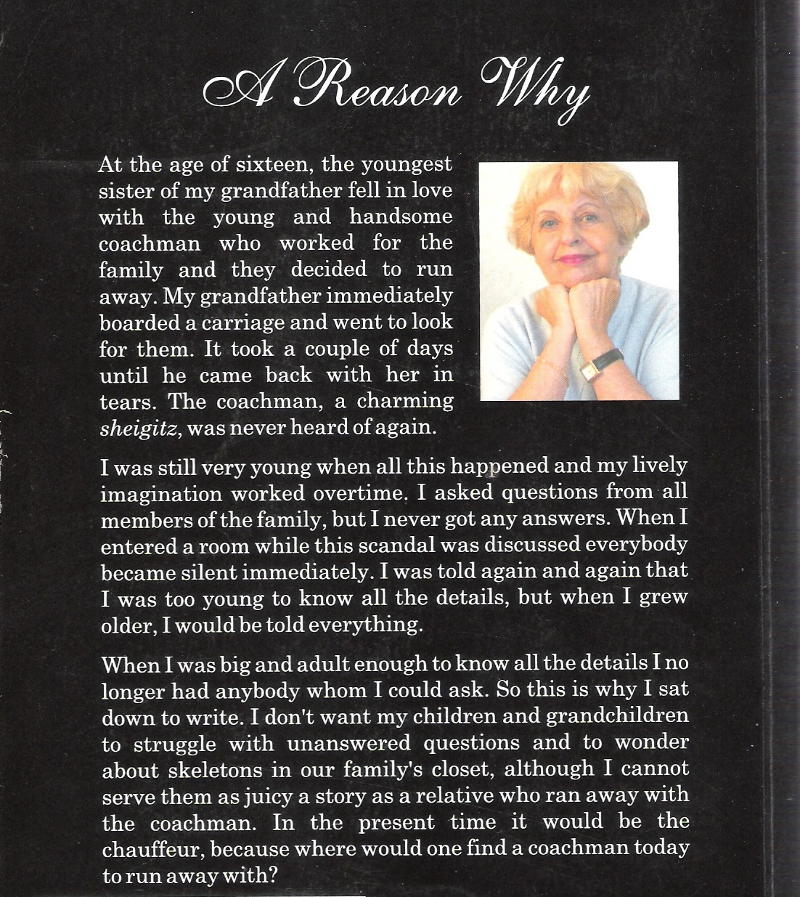
From Irene Fishler

My first contact with Lucca and our first meeting.
Everything happened in November 2005, thanks to… Ehpes !
Irene

—– Original Message —–
From: Irene
To: Lucca Ginsburg
Sent: Sunday, November 27, 2005 10:26 PM

Dear Lucca,

My name is Irene Fishler and I live in Haifa. 2 weeks ago I joined the Czernowitz2006 Group. Today I looked at your photos-collection on the Cz.- L group site. Since then I am going through a big excitement, I hardly calmed down. It’s about the Meisler Schule.

Tante Lea was my mother Leonore (Lea ) Ehrenkranz , geb. Kraemer.

Frau Singer was my beloved Tante Flora (geb. Kraemer).

Frau Direktor Meisler was their Tante Berta, my grandmother’s sister. It was a women- family- business and a teacher’s dynasty. I myself was for 26 years a teacher in Haifa, now retired…

Where do you live in Israel? I’ll be pleased to talk to you. What language do you prefer: Hebrew, Rumanian or German?

Can you please write your phone number? When do you like me to call?

Best wishes
Irene

============================

Dear Irene,
I think that I am not less excited than you were when looking at the Meisler schule photos!
I published them – I think – more than a year ago and up to now nobody reacted, I so hoped to hear from a previous school friend – and now, here, I get a much more exciting reaction from someone who was part (at least indirectly) of my early and really so happy years of my childhood!!

I loved “Tante Lea”! And Mrs. Singer, oh well, what can I tell you? Up to the present time I thank her in my heart for my fluent written German (as an executive secretary in foreign languages she contributed to my profession)/ One of my most priced possessions is a letter I received from her which arrived from Bucharest to the small island in the Caribbean where I spent 8 years with my parents.

Generally, those years in the Meislerschule were the happiest of my childhood because, as you know so well, our troubles started in 1940, when I was 10 years old. I never managed to visit the Carmen Sylva Lyceum which my parents had chosen for me!

My mother language is still German, I am also still fluent in Rumanian, but do not have much opportunity to use it. I too live in Haifa, for the last 1 1/2 years in the Elisha Towers (not due to health problems but due to personal tragedy, which I will tell you about.) I have one daughter plus family in San Diego, I just returned from there two weeks ago, and I have a married son in Frankfurt . My telephone number is 8100703, cellphone 052-3800531 unfortunately I often forget it at home …

Please, PLEASE, Irene call me! Elisha is full of activity, fitness center, swimming pool, all kinds of programs every day at 6 p.m. I do whatever I can! Best time to reach me is from 1 p.m. to 2, or in the evening after 9.
I am so looking forward to hearing from you.
In the meantime a hug,
Lucca

Story by way of Gaby Rinzler

From Gaby Rinzler

This incident took place in Bergen-Belsen immediately after the war
under the jurisdiction of the Allies. The surviving inmates were now
free to create new lives for themselves but many had no place to go.
These remained in the camps awaiting a solution to their problem.

An amazing story.

The Wedding Gown That Made History

Lilly Friedman doesn’t
remember the last name of
the woman who designed and
sewed the wedding gown she
wore when she walked down
the aisle over 60 years
ago . But the grandmother
of seven does recall that
when she first told her
fiancé Ludwig that she had
always dreamed of being
married in a white
gown he realized he had
his work cut out for
him …..

For the tall, lanky
21-year-old who had
survived hunger, disease
and torture this was a
different kind of
challenge . How was he
ever going to find such a
dress in the Bergen-Belsen
Displaced Person’s camp
where they felt grateful
for the clothes on their
backs?

Fate would intervene in
the guise of a former
German pilot who walked
into the food distribution
center where Ludwig
worked, eager to make a
trade for his worthless
parachute . In exchange
for two pounds of coffee
beans and a couple of
packs of cigarettes Lilly
would have her wedding
gown .

For two weeks Miriam the
seamstress worked under
the curious eyes of her
fellow DPs, carefully
fashioning the six
parachute panels into a
simple, long sleeved gown
with a rolled collar and a
fitted waist that tied in
the back with a bow . When
the dress was completed
she sewed the leftover
material into a matching
shirt for the groom .

A white wedding gown may
have seemed like a
frivolous request in the
surreal environment of the
camps, but for Lilly the
dress symbolized the
innocent, normal life she
and her family had once
led before the world
descended into madness .

Lilly and her siblings
were raised in a Torah
observant home in the
small town of Zarica ,
Czechoslovakia where her
father was a teacher,
respected and well liked
by the young yeshiva
students he taught in
nearby Irsheva . He and
his two sons were marked
for extermination
immediately upon arriving
at Auschwitz . For Lilly
and her sisters it was
only their first stop on
their long journey of
persecution, which
included Plashof,
Neustadt, Gross Rosen and
finally Bergen-Belsen ..

Lilly Friedman and her
parachute dress on display
in the Bergen-Belsen
Museum

Four hundred people
marched 15 miles in the
snow to the town of Celle
on January 27, 1946 to
attend Lilly and Ludwig’s
wedding. The town
synagogue, damaged and
desecrated, had been
lovingly renovated by the
DPs with the
meager materials available
to them. When a Sefer
Torah arrived from England
they converted an old
kitchen cabinet into a
makeshift Aron Kodesh.

“My sisters and I lost
everything – our parents,
our two brothers, our
homes. The most important
thing was to build a new
home.” Six months later,
Lilly’s sister Ilona wore
the dress when she married
Max Traeger .. After that
came Cousin Rosie. How
many brides wore Lilly’s
dress? “I stopped counting
after 17.” With the camps
experiencing the highest
marriage rate in the
world, Lilly’s gown was in
great demand.

In 1948 when President
Harry Truman finally
permitted the 100,000 Jews
who had been languishing
in DP camps since the end
of the war to emigrate,
the gown accompanied Lilly
across the ocean to
America . Unable to part
with her dress, it lay at
the bottom of her bedroom
closet for the next 50
years, “not even good
enough for a garage sale,
I was happy when it found
such a good
home.”

Home was the U . S .
Holocaust Memorial Museum
in Washington, D. C. When
Lily’s niece, a volunteer,
told museum officials
about her aunt’s dress,
they immediately
recognized its historical
significance and displayed
the gown in a specially
designed showcase,
guaranteed to preserve it
for 500 years ..

But Lilly Friedman’s dress
had one more journey to
make. The museum at
Bergen-Belsen opened its
doors on October 28, 2007.
The German government
invited Lilly and her
sisters to be their guests
for the grand opening
They initially declined,
but finally traveled to
Hanover the following year
with their children, their
grandchildren and extended
families to view the
extraordinary
exhibit created for the
wedding dress made from a
parachute.

Lilly’s family, who were
all familiar with the
stories about the wedding
in Celle , were eager to
visit the synagogue . They
found the building had
been completely renovated
and modernized . But when
they pulled aside the
handsome curtain they were
astounded to find that the
Aron Kodesh, made from a
kitchen cabinet, had
remained untouched as a
testament to the profound
faith of the survivors.
As Lilly stood on the
bimah once again she
beckoned to her
granddaughter, Jackie, to
stand beside her where she
was once a kallah . “It
was an emotional trip . We
cried a lot. ”

Two weeks later, the woman
who had once stood
trembling before the
selective eyes of the
infamous Dr. Josef Mengele
returned home and attended
the marriage of her
granddaughter.

The three Lax sisters –
Lilly, Ilona and Eva – who
together survived
Auschwitz, a forced labor
camp, a death march and
Bergen-Belsen – have
remained close and today
live within walking
distance of each other in
Brooklyn. As mere
teenagers, they managed to
outwit and outlive a
monstrous killing machine,
then went on to marry,
have children,
grandchildren and
great-grandchildren and
were ultimately honored by
the country that had
earmarked them for
extinction.

As young brides, they had
stood underneath the
chuppah and recited the
blessings that their
ancestors had been saying
for thousands of years. In
doing so, they chose to
honor the legacy of those
who had perished by
choosing life ..

IN MEMORIAM – 63 YEARS
LATER

It is now more than 60
years after the Second
World War inEurope ended.
This e-mail is being sent
as a memorial chain, in
memory of the six million
Jews, 20 million Russians,
10 million Christians and
1,900 Catholic priests who
were humiliated, starved,
murdered, massacred, raped
and burned, with the
German and other peoples
looking the other way…

Now, more than ever, with
Iraq , Iran , and others,
claiming the Holocaust to
be ‘a myth,’ it is
imperative that the world
never forgets, because
there are others who would
like to do it again …

Please pass this on .. . . . lest we forget!
5 WWI photos from Hedwig Brenner


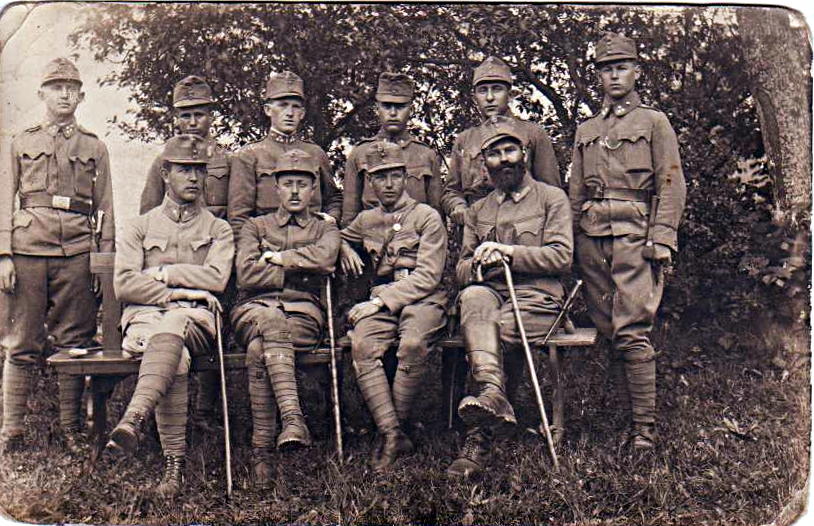
The 2 brothers of my mother, Rudolf and Emil Fuerstein. Handwritten by Rudolf: For remembering on our accidental meeting in Laibach, the 21.4 .17, your faithful brother Rudi. (was already lawyer Emil was 10 years younger, at 18 he went as volunteer, called an Einjaehrig-Freiwilliger)


WW1 Before going to the battle: In the second row, in the middle, with some blackbook? in the hand, is my mother’s cousin Dr. Norbert Gross, from Czernowitz.


Emil Feuerstein with other soldiers. Standing (back row), the first of right is my 18-year-old uncle.


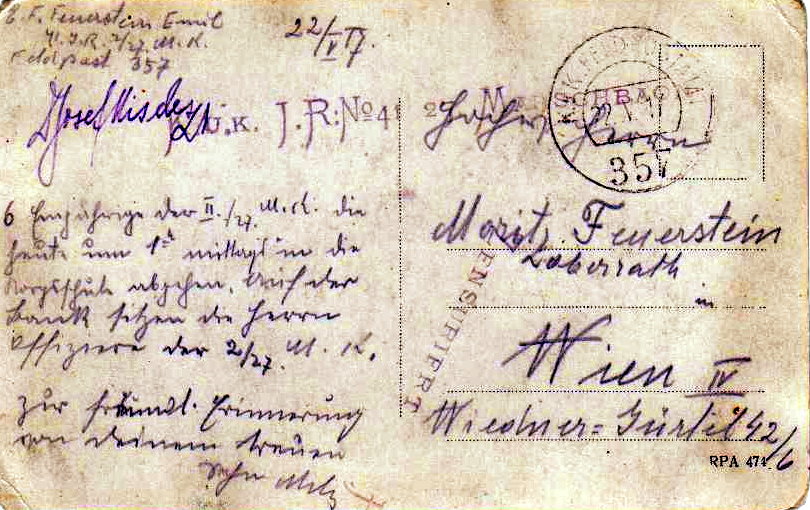
Reverse side of photo above: *Note — if you can translate the cursive script on this card, please do so and leave it as a comment for this post. I will then add it to the caption text –jerome
Here’s the translation from Hedwig:
Translation :
One-year-volonteer Feuerstein Emil 41.I.R.7/27 11.K.
Dr.Josef Miseles LAi J.R.No.41
6 one-year-volonteers of 11/27 M ch, who are leaving to-day at 1 ocl. noon for the war school.
On the bench are sitting the mister officers of the 2/27 41 I r i
For friendly remembrace yor faithful son, Miliu


Uncle Rudi (Rudolf Feuerstein) wounded, has a little story: When he was going to war, my grandmother put around his neck a small medallion on a golden chain, as a talisman. In the battle the chain was broken, so he put the medallion in the left pocket of the uniform. Suddenly came a bullet straight to his heart, burned a hole in the uniform and was stopped by the medallion. But an other bullet made a deep wound in his leg, so he was in the field-hospital. The commander gave him the uniform as a remembrance.

Offenberg Relative – do you recoginize?

From Hedwig Brenner

Looking for some pictures, I found this lady, Offenberg, a distant relative of my mother in law.

She arrived in Czernowitz illegaly in 1942 from Poland with her husband and a baby. She was hidden by other relatives and asked us for some “Luminal” a medicine for sleep, to give her child, otherwise her uncle was afraid to host them.

If the Germans or Roumanians will catch them, they will be sent to an extermination camp… Mother gave her some tablets and she disappeared, we never heard about them again.

Does someone on this list know of this woman Offenberg? That name is written on the back of this photo.

Hedwig

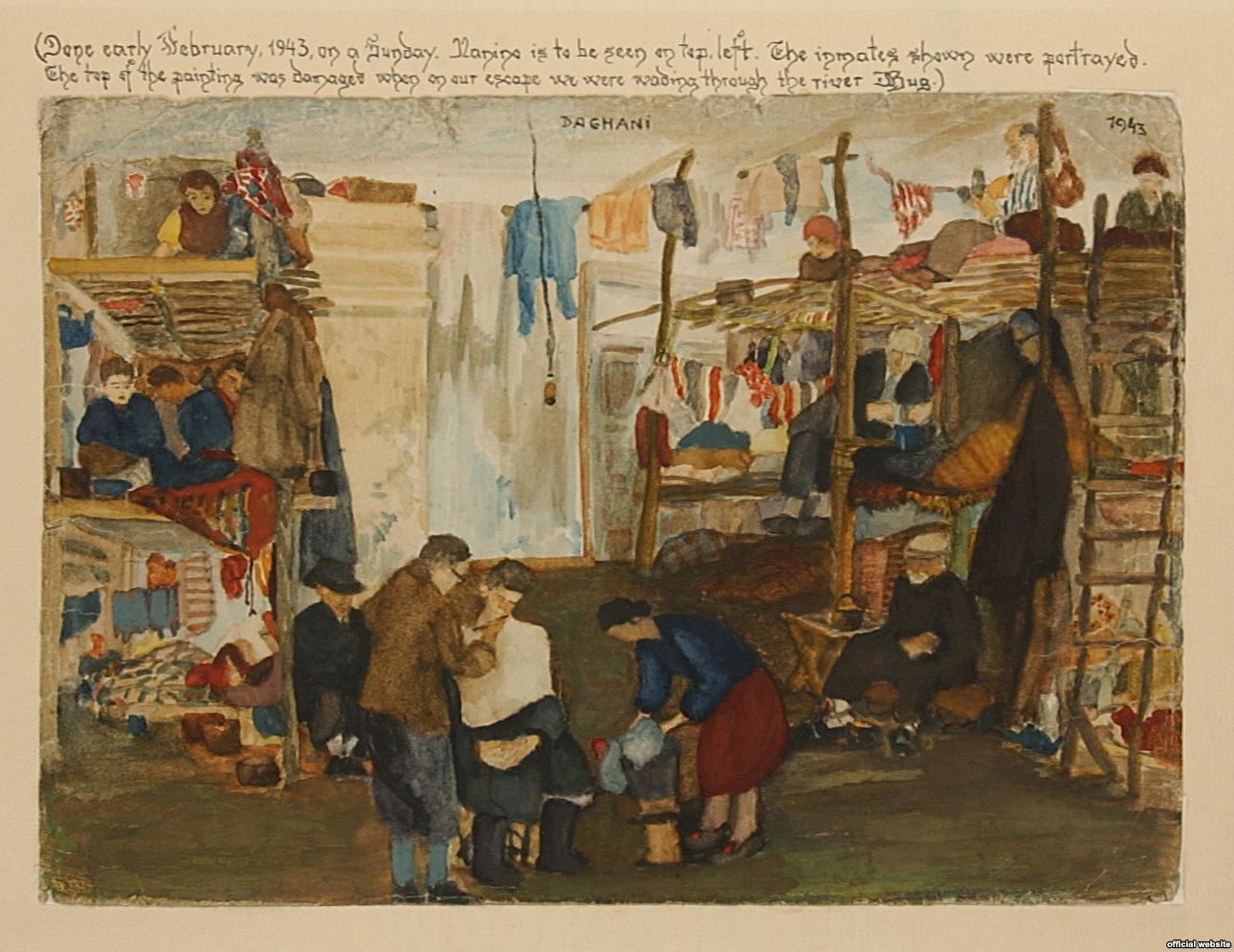
“Arnold Daghani. Who is he?” by Miha Ahronovitz!

FD00272A-8B69-4654-BBB6-4C565E418EDE_mwdynamic_mhdynamic_s

Arnold Daghani. Who is he?

Arnold Daghani was born in Czernowitz, (not Suczava as other sources say) and he was a German speaking Romanian Jew. Some consider him today one of greatest artists of Europe in the 20th century. During his life, he had failure after failure.
He married his first and third wife (he called her Nanino)  Rabinovitz, in 1940. His second wife was Gabriela Miga
I met him in Bucharest around 1955. Daghani impressed me with his British look wearing  tweed jackets and smoking a pipe. I was ten at the time and he was my English tutor, the most expensive English tutor in Bucharest under the Stalin-style communist regime. I did not learn much English.  He did all the writing with clear letters, while I was watching him. I was dreaming,  me a ten year old boy, with him, a man in his forties, to escape to the Free World. He had an Airedale Terrier dog. One day, to show it to me, he walked for two hours from the other end of the city. We did not have sneakers in those days People did not have dogs in apartments. One can not even buy dog food. Human food was on coupons. So an Airedale Terrier looked very Western to me.
Continue reading the story on Miha Ahronovitz’s blog: Pictures from the Invisible

“The HORN Identity” by Marla Raucher Osborn

“A Teacher Returning: Bronia HORN”
80 Years After Leaving Poland for Palestine, a Visit to her School in Busko-Zdrój

I am not her granddaughter, but I could have been.

Bronia HORN was my paternal grandmother’s aunt. There was only a 6-year age difference between Bronia and my grandmother. Bronia was born in 1904, my grandmother in 1910.

Both were born in Rohatyn, in what was then Eastern Galicia, today Western Ukraine. Both left Rohatyn. For my grandmother, the destination was New York in 1914 with her father Isak (almost 20 years older than younger sister Bronia), her mother, and her two sisters. For Bronia, it was Palestine in 1936, to join her older sister Jute who had emigrated there two years prior. Neither Bronia, Jute, or my grandmother would ever see there beloved Rohatyn again. Continue reading

Lucca Ginsburg in Curacao

Mark Wiznitzer wrote to the group on 19 May:

>>There is a photo in “Shtetl Under the Sun – The Ashkenazic Jewish Community
of Curaçao” of Lucca circa 1948 playing the accordion while three children
(one is my oldest sister) in sailors outfits are dancing. She told last year
that she was part of the community for three years after leaving Europe. I
never met the wonderful woman, but this image is how I will picture her always.

He has today (21 May) sent along the photo, and says: “Attached for inclusion on the website is a scan of the photo of Lucca Koch playing the accordion circa 1950 in Curaçao, at a celebration of Israel’s independence which appears on page 200 of “A Shtetl Under the Sun – The Ashkenazic Community of Curaçao” by Jeannette van Ditzhuijzen.” The children are Lily Bonaparte, Johnny Wachtel and Rita Wiznitzer.

if you click on the image below, you will get the ‘full sized’ photo which you can download

Best,
jerome

Two Czernowitzer Ladies in Bucharest!


Netka and Rachelle Peretz

Netka an Rachelle Peretz in front of th Bucharest Main Post Office.
In 1972 it became became the National Museum of History.

 
Alternate utilization due to parking place shortage in Bucharest.

The Czernowitzer newspaper “Der Tag” is reporting on the stylish
window display of the sporting goods store M. Gelband.