Rohatyn and Bukovina Memorials at the Kiryat Shaul Cemetery in Tel Aviv

1

Marla Raucher Osborn at the Kiryat Shaul Cemetery in Tel Aviv, with Rohatyners standing before the Rohatyn Memorial to the victims of the Shoah

Nash Holos Ukrainian Roots Radio broadcast on “Ukrainian Jewish Heritage – Rohatyn”


OLYMPUS DIGITAL CAMERA

Bukovina Holocaust Memorial at the Kiryat Shaul Cemetery in Tel Aviv

JEWISH GALICIA & BUKOVINA: Galicia and Bukovina were major Jewish centers as far back as the 13th Century and were home to over one million Jews, with unique cultural characteristics and a vibrant intellectual and spiritual life. These regions produced prominent Jewish thinkers, rabbis and Hassidic courts, who created influential texts and institutions that have had a long-lasting impact on the Jewish world. The Torah scholars and Jewish intellectuals of Galicia and Bukovina were known for their tolerance and openness towards modernity, while being firmly rooted in Jewish tradition and learning. This thriving Jewish world was wiped out in the Holocaust.

First Autobus Lines in Czernowitz

Autobuz_pt_Cernauti_inainte_de_livrare_1933

Autobus in Brașov in 1933 before delivery to Czernowitz

Putting into operation of 10 autobuses, bearing the car numbers 310-319 by I.E.C.M. [Electromechanical Corporation of the Municipality of Czernowitz] on August 26, 1933, servicing three permanent and two seasonal bus routes. The autobuses, Type Fiat 622, assembled in Brașov, were dark red, had a 45 HP engine, 19 seats on luxury leather benches, ventilation systems and double doors, manually or automatically operated by the driver. The bus garage has been erected next to the tramway depot.
Source: http://www.transira.ro/bb3/viewtopic.php?t=4706

Autobuze_Cernauti

Autobuses in Czernowitz in front of the bus garage

Cz.Map_Tram+Bus_1935

Short-range transit in Czernowitz during the pre-WW2 period

330906c1 Kopie

“Der Tag”, Czernowitz, September 6, 1933 edition

Der Omnibus

Durch einige Hauptstraßen der Stadt eilt seit einigen Tagen der städtische Omnibus. Der Anfang ist gemacht: Das Verkehrsnetz der Straßenbahn ist um wenige Linien erweitert worden. Daß es nicht Straßenbahnlinien sind, die, die mit der elektrischen Tramway befahren werden, sondern Omnibusse, tut weiter nichts zur Sache, denn nach den äußeren Erfahrungen des Straßenbahnverkehrs ist die Ersetzung von Straßenbahnlinien durch Omnibusse praktisch, rentabel, dem Verkehr zuträglicher und für das Publikum geeigneter. Was seit Jahren angestrebt wurde, nämlich die Erweiterung des Straßenbahnnetzes, ist also endlich durchgeführt, man muß sich über diese Errungenschaft freuen und die Tat soll anerkannt werden.

Aber was wir mit Bedauern sehen, ist, daß das Publikum den Omnibus meidet, jedenfalls zaghaft den Straßenbahnwagen betritt und im großen und ganzen eine abwartende Haltung einnimmt. Seit mehr als dreißig Jahren ruft die Stadt nach der Erweiterung des Straßenbahnnetzes, endlich ist die Ausdehnung erfolgt, aber für den Czernowitzer gilt hier das Wort: Omnibus ist Omnibus und Tramway ist Tramway. Oder im weiteren Sinne: der Omnibus ersetzt nicht die Tramway. Es ist eine Auffassung, die dieser Stadt paßt und es wäre ein Wunder, wenn es anders wäre. Aber man darf nicht verzagen, hier muß Erziehungsarbeit geleistet werden, es muß dem Czernowitzer beigebracht werden, daß er endlich das hat, wonach er seit Tag und Jahr schreit, das moderne und billige Verkehrsmittel, das alle Verbindungen kreuz und quer schafft und das berufen ist, den Verkehr und damit auch das wirtschaftliche Leben zu fördern. Es muß auch hier der Grundsatz gelten, daß nicht der Verkehr die Tramway geschaffen hat, sondern die Tramway den Verkehr schaffen muß, und daß das, was heute leider noch nicht zu hören ist, nämlich die Zunahme des Verkehrs mit dem Omnibus, in paar Wochen oder in paar Monaten eintreten wird. Diese Erziehungsarbeit muß die Tramwaydirektion vornehmen. Dazu ist notwendig, daß der Omnibus sich auch an bestimmte Abfahrtzeiten gewöhnt, nicht an einer Station stehen bleibt und eine Ewigkeit wartet, bis genug Gäste kommen, ferner daß die Station genau bezeichnet wird, also richtige Haltestellen etabliert werden, kurz, daß der Verkehr in ein System gebracht wird. Es darf nicht geschehen, daß die Konkurrenz heute und morgen auf den neuen und schönen Omnibus, eine Zier des Stadtbildes, höhnisch und verächtlich weise, als ob Czernowitz in einem Anfalle von Größenwahn sich einen modernen Omnibus angemaßt hat, der ihm nicht gebührt – nein, das darf nicht sein. Der Omnibus ist eine Notwendigkeit, kein Luxusstück, sondern so notwendig wie das Wasser. Es darf die Gemüsefrau von Rosch sich nicht vom Verkehr fernhalten. Der Omnibus ist nicht für die reichen und eleganten Menschen, sondern für das Volk da. Und weil es so ist, muß auch die Tarifbestimmung sich diesen Erfordernissen anpassen. Wir sehen, daß auch die Organe sich mit dem Omnibus nicht richtig befreundet haben. Der Schaffner sitzt im Wagen, wenn die Station kommt, er muß bei der Station aussteigen, beim Aus- und Einsteigen behilflich sein. Es muß also der richtige Dienst am Kunden versehen werden. Es sei das Geständnis abgelegt, daß wir für den Omnibus die größte Propaganda führen wollen, gerade deshalb, weil er noch heute gemieden wird. Der konservative Czernowitzer soll sich zuerst an das neue Verkehrsmittel gewöhnen und bald wird der Omnibus zu dieser Stadt so gehören, wie Czernowitz ohne den alten Rathausturm nicht zu denken ist.

Ego.
Yom Hashoa

I am in Florida for a long weekend with my wife. We walked into the Beth David synagogue in Palm Beach Springs for a Yom Hashoah observance which we heard was taking place. There was a small turnout of people reading names out loud, the entire day, of those who perished. My wife and I were asked to read names for 20 minutes. Not knowing my past, we were handed a list of names to read of those who perished from Romania in Transnistria. Irony or coincidence? I included names of my mother’s brother – Leopold End, her father – Lazar End, and her step mother -Sali End.

We should never forget. I have been told that one can forgive without reconciling. Perhaps I will try this one day. Perhaps.

May the blessed memories of those who perished never depart.

Stephen Winters

Three Schools in Czernowitz – Three Class Photos

98___d9a76d9f3cf080d75939b6e26e855a83

Aron Pumnul Gymnasium in Czernowitz, Class VI B, Academic Year 1937-1938

83___7a2fff53a69ceb2a7bc61fe993b6e1d8

Comenius Private School in Czernowitz, Class IV, Academic Year 1936-1937
All students were Jewish; at the left director Eusebiu Jemna, at the right form-master Isidor Mehler.

71___76259646fbe686d600f1d692501df1c4

Gheorghe Tofan Elementary School in Czernowitz; in the middle director Eusebiu Jemna and a young student teacher.

Source: Mircea Jemna Collection at Memoria.ro

A Shtetl in the Caribbean

Read more and contribute to the realization of the project at:
http://www.cinecrowd.nl/een-sjtetl-de-cariben?language=en

Mark Wiznitzer: “Language and culture are so intertwined. My father left Vascauti (Vashkivtsi, Vashkowitz) 40 km from Czernovitz in Bukovina in 1927.He attended cheder and did not have the opportunity to complete his education because he left Romania with his older brothers while in his mid-teens. But he eventually learned to do business in 7 languages, including Japanese. But Yiddish was his first language, in which he wrote to his brothers using Hebrew letters. My maternal grandmother, having finished gymnasium in Dresden where my mother was born, and her Polish-born university-educated husband, spoke German. But their other European languages came in handy as they had their other children in France and Belgium, and settled first in Colombia, and ultimately in Curaçao. To assimilate, my grandfather added “Montevenado” to his name, a Spanish translation of his surname. And so the name on his gravestone in the ancient Jewish cemetery Beit Haim Blenheim reads “Max Hirschberg Montevenado”. My mother, having received a Dutch education in Curaçao was fluent in several languages. But she did not learn Yiddish until she and my father made it through WWII in Japan, where they lived with my father’s cousin from Czernovitz and socialized with other Jews from Eastern Europe, as well as Iraq and Syria. When my parents returned to Curaçao in 1946, Yiddish came in handy as the language of the growing Ashkenazi community, which had reached a sufficient critical mass to resemble a “Shtetl”. In Curaçao we Ashkenzi Jews were callled “Polacos” because the first to arrive came from Polish Galicia, ironically from Snyatin, immediately across the Cheremosh river from, and the nearest town to, my father’s birthplace. My childhood classmate, Sherman de Jesus, lived near our community’s Shaarei Tsedek synagogue and social Club Union. He was fascinated by our community early on. A successful documentary producer and director, he is now completing a film project on the Shtetl in the Caribbean. At the link above, there is a clip of some scenes shot so far in Bukovina, Belarus and Israel.”

Lyceum Mihai Eminescu


From Gaby Rinzler:

In the center is Professor Goraj,director and co-owner of the private lyceum Mihai Eminescu.

Gaby-hs

It looks like a graduating class (because of the glasses in their hands)
It is probably 1939-40. I can’t remember how I got in this picture. I am the obviouly younger kid with the open mouth. Many of the boys look very familiar to me but I cannot afix names to them. The big head on the right lower corner may be a cousine of mine Arno Rosenwald..

[I wish to see] if any body recognizes somebody?

Gaby

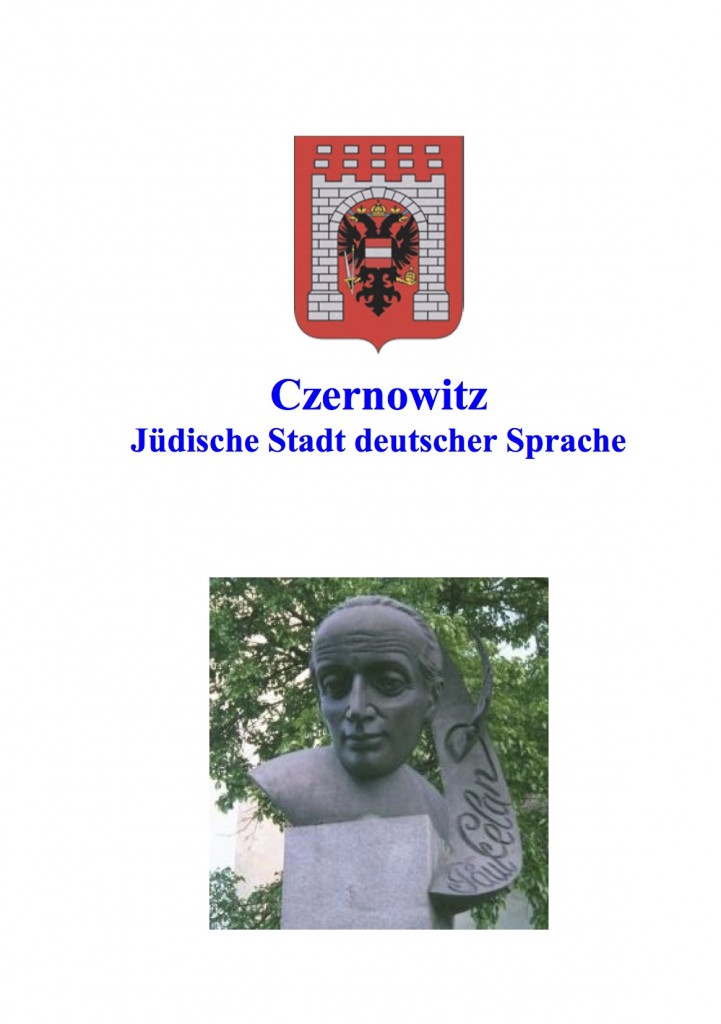
Czernowitz – Jewish City of German Language

!Cz2allesClick on the front cover for a – free – copy of Friedrich J. Ortwein’s book!

Friedrich J. Ortwein: “Up until now, I was profoundly convinced, that the love and the devotion of the citizens of Cologne to their home town, the antique CCAA (Colonia Claudia Ara Agrippinensium), one of the Daughters of Rome and free imperial city, cannot be exceeded by anybody in the world. But during the travel preparations for our journey to Galicia and Bukovina, when I came across the website of the Jews expelled from CZERNOWITZ, I had to reverse: The children and grandchildren of Czernowitzers, together with a few Holocaust survivors, have created a website containing a huge data volume and so they emphasize in an unique and inimitable way their love for the home country of their ancestors.

Forum members from all over the world, from the Americas, from Australia and South Africa, from Israel and Europe analyze, comment and swap ideas on events, research their genealogical roots, discuss and value rediscovered archival materials, enjoy old and new photos, exchange holiday and birthday wishes and all this happens in English with embedded German, Yiddish and Hebrew particles.”