Re: Ghostlike appearances; portraits on gravestones

Christian’s recent post about portraits seen on gravestones in the Czernowitz Jewish cemetery <https://vanishedworld.wordpress.com/2015/04/25/ghostlike-appearences/> reminded me that these portraits occur in New York City cemeteries as well.  Several years back I went searching for the tombstone of Sarah Silver at the Mt. Hebron Cemetery, Queens, New York.  Sarah was born in Radautz, and was a sister of my great grandmother, Hinde Schachter nee Brucker.  She lived in Montreal, then Cleveland, and died unexpectedly during a visit with another sister in New York City.  Her tombstone bears the only photo I’ve ever found of her.  See below.

OLYMPUS DIGITAL CAMERA

OLYMPUS DIGITAL CAMERA

IF

IF

Czernowitz Cemetery Transcription Project

After too many years, the Cemetery database project is nearing completion. There are just about 3000 burials remaining to index. (For those who aren’t familiar with it, results are posted to The JewishGen Online Burial Registry at <http://www.jewishgen.org/databases/Cemetery/>.) Transcriber Noam Silberberg recently spotted an unusual monument in Area 102, recording the passing of Dr. Karl Nussenbaum, who died in a plane crash in 1938.  Does anyone remember or know anything about this event?214-1486_IMG
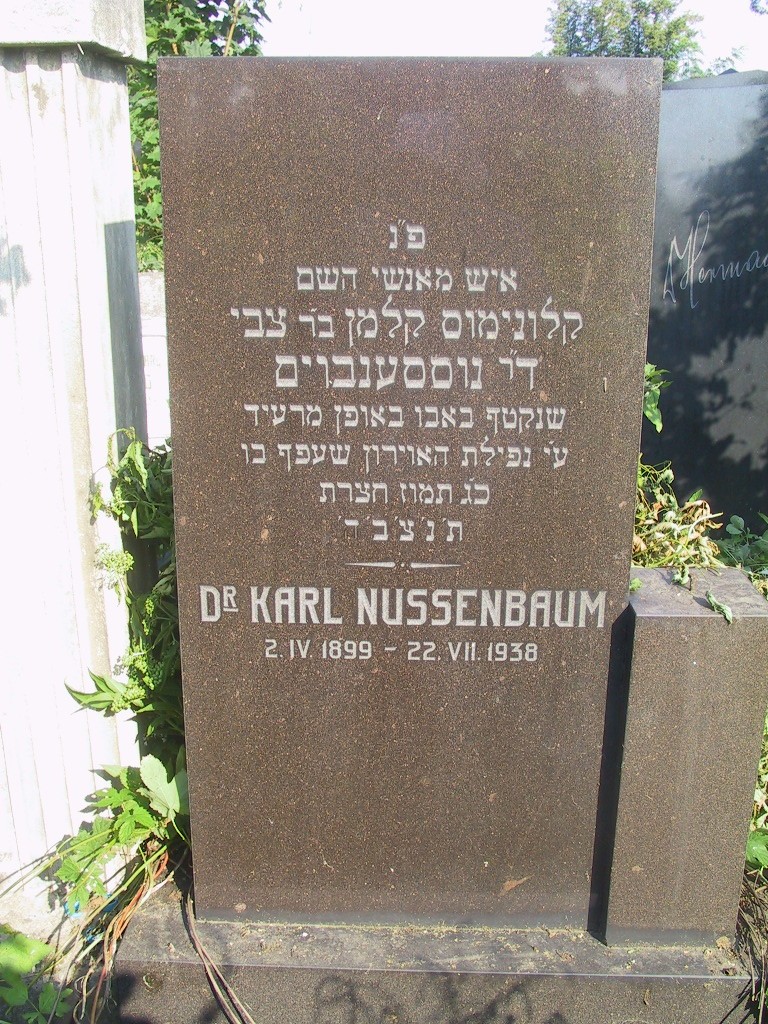
 

I’d be interested to know more!

Bruce Reisch


April 25, 2015: 21:00 ET:

Noam Silberberg send the following related information:

The plane was a Lockheed 14H Super Electra of the Polish LOT airline
flying on the Warsaw-Lwow-Czernowitz-Bucharest-Thessaloniki route. On
July 22nd, 1938 at around 17:40, it crashed after being struck by
lightning near Stulpicani, Suceava county. There were 14 people on
board, all killed.
 
Crew members were pilot Wladyslaw Kotarba, radio operator Zygmunt
Zarzycki and flight engineer Franciszek Panek.
On board were also two military pilots – Capt. Gnys and Capt
Waliszewski; aviator Olimpiusz Nartowski; Polish diplomat Edward
Gozdowski and Japanese military attache Col. Masakatsu Waka.
Other passengers were Dr. Lemuel Caro (Goldstein) from New York and
Bulgarian diplomat Radi Radev.
In Czernowitz boarded Dr. Isidor Bodea, director of the children’s
hospital in Czernowitz; Dr. Karl Nussenbaum; Capt. Gheorghe Ionescu
and Romanian composer and aviator Ionel Fernic.
Noam.
 
April 25, 2015 21:00 ET:
Irene Fishler shared additional information:
From Noam Silberberg’s very interesting comment I learned that on this
flight was also Dr. Isidor Bodea.
 
By chance, I have a photo I took at the Children’s Hospital main building
with a commemoration plaque on its wall. ( see below).
 
It reads , in Romanian: “Dr. Isidor Bodea ( 1866-1938) the first
chief-physician of the Children’s Hospital in Cernauti”
As far as I know Dr. Bodea was not Jewish.
 
If you think it’s worth, please post it on the Ehpes-Blog.
Thanks for everything you do,
 
Best regards,
Irene
Cz_Children'sHospital_MAy2011_658
Cz_Children'sHospital_May2011
April 25, 2015 21:30:
Ignacio Sternberg contributed the following:
Hello Bruce and Noam & Hardy

I am answering you from Caracas, Venezuela, regarding Bruce’s interest in Dr. Karl Nussenbaum. He was a cousin of mine.My mother’s mother (my GM ) was a NUSSENBAUM. The source of the information came from Claudia, daughter of Karl N. He studied medicine in Vienna. Anything else you need just write me. I think I have the best tree of the Nussenbaum’s !!!!! as told by them. (example below)
 
Individual Report for Kalman ( Karl ) Bubie Nussenbaum.jpg
April 27, 2015, New contribution from Mordecai Lapidot:
All I can contribute is just an account of a 5y+4 months year old ear-and-eye witness.
My parents and I usually spent a week or two in the summers before 1940 in Gurahumora, where my father’s cousins (the Apter family) lived.
I recall vividly that evening, in the summer of 1938, and that disaster. It was a typical summertime thunder-and-lightning strom night, and my parents and I stood at the window of our room, fascinated by the lightnings that lit the darkblue sky.
Suddenly we heard and saw a little plane in the sky, and after a few seconds there was another lightning, followed this time by a thunderous explosion. We saw suddenly people running in the streets and a few carriages passing quickly in a particular direction.
The next morning we learned from the neighbours that the plane had been struck by lightning and had crashed in some “nearby” wood. The site of the catastrophe had become a “celebrity” with many peasants from the villages around gathering to visit it.
I have no good explaination, but this is my only crystal-clear and vivid memory of the summers in Gurahumora (which is not too far from Stulpicani). The scene of the room we were in, as well as of the short period we stood at the window and the events that we saw and heard, was many years – and still is – clear and vividly imprinted as a frame before my eyes. I suppose the tragic catastrophic crash that I witnessed made an indelible impression on my mind, and the intact disquette is still there, the resolution not reduced by the nearly 77 years that have passed.
Shavua Tov
Mordecai
April 27, 2015, Additional information from Irene Fishler:
Hardy and Mordecai , congratulations to your fine memory !
Here is another victim of the crash: Fernic Ionel ( 1901-1938)
He was first an actor ,then a popular composer of light music ( over 400
tangoes, etc).
His great love was aviation and …parachute jumping.
After a bad accident, in 1936 he took the job of director of the Pilots
School ARPA in Czernowitz.
In June 1938 he wished very much to go to Bucharest to the funerals of Queen
Maria.
But, the Lot airplane crashed into the dark forests of Negrileasa , near
Stulpicani…
The story is here:
Regards,
Irene
Thank you everyone for filling in the details of this tragedy – all surfacing because of an inscription on a stone in the Czernowitz Jewish Cemetery.
Bruce Reisch
Geneva, New York
Physicians [from Czernowitz], Deported to Transnistria

maresalul-ion-antonescu-si-basarabia

FreeDownloadExcerpt

Ervin [Erwin] Adler, Ioan Blidner, Leopold Bremer [Brenner], Lazar [Lezer] Buxbaum, Maier Drucher, Isidor Furmann, Natan [Nathan] Ghetzler [Getzler], Iosif Goldstein, Solomon Heier, Suchar Herschman, Martin I. Herzberg [Hertzberg], Iuda Hollinger [Holinger], Guido Hornstein, Iosif Iahr, Julius Kessler, Berl Korn, Karol [Carl] Korn, Max Kremer, Carol [Karl] Leindenbaum [Lindenbaum], Isac Likvornic, Comrat [Iacob Conrad] Mardler [Merdler], Pincas Napler, David Nier, Ossi [Ossy] Orest Noe, Iacob Rauch, Arthur Rosemblat [Rosenblatt], Iulius Rotlender, Izu Salzberger, Ludovic [Ludwig] Samler, Leizer [Leiser] Schachter [Schächter], Paul Pincas Schapira, Zigard Scherf, Adolf Schifter, Simion [Simon] Schlosser, Wilhelm Schvartz, Carol Schwartz Skapf [Schwartzkopf], Alfred Seidner, Wilhem [Wilhelm] Solomon, Natan Teitler, Isac Vikman, Herman Walter, Hema [Herman] Wasz Kutzer [Waszkautzer], Baruch Wenistock [Weinstock], Adolf Winter, Bernhard Teodor Zulflucht [Zuflucht].

150382_original

Captured by Dr. Sergij Osatschuk at Czernowitz Street Market in January 2010

Ain’t Love Grand?

From the mercurial Shelley Mitchell, this fine piece of photography….
shelley
Here’s what Shelley has to say about the photo: “These are my maternal grandparents, Beile “The Belle of Kolomea” Terner and her (then finance and later) husband, Zalman Konigsberg. This is the Galician side of the family.”

Memory Treatment and Urban Planning in L’viv, Chernivtsi, Chisinau and Wroclaw

Bildschirmfoto 2015-04-10 um 14.47.45

Click here for accessing the Research Project Memory of Vanished Population Groups in today’s East-Central European Urban Environments.

Click here for dowloading the brochure „What is to be remembed?“ on Chișinău [p. 6-16], Czernowitz [p. 16-30], Lemberg [p. 30-49], Wroclaw [p. 49-62].

Click here for downloading Leo Spitzer’s brochure “Connective Memories: Dreams, Mediascapes, Journeys of Return”

From Anne-Mette Prent of Norway – Her Czernowitz Connection


Just received today from Anne-Mette Prent of Norway, and I hope she will write soon to the list telling us more about the following documents.  Here is an abbreviated version of what she just wrote to me:

Hello Bruce,
A friend has helped me to scan some of the documents from my grandmother. Here are “ Heiratsurkunde”( 2 pages) “Trauungs-Matriken-Schein”( 2 pages), Lehrbefahigungs-Zeugnis”, and two pictures from Weissensee graveyard in Berlin. The poem on Karl Ernst`s stone, I am very anxious to know if anyone in the group knows anything about. I have asked Germanists here in Oslo, but it seems to be quite unknown to all. The inscription on my great-grandparents` stone is in Hebrew, and I have already sent you the German translation. All these documents are in German, my German is worse than my English, consequently, it`s been a job translating everything into Norwegian. But it has been rewarding! I got around 100 documents from The Archive, most of them in Norwegian. I also got papers from the German SS in connection with my uncle Karl Ernst, he commited suicide while being tortured in Berlin, since he was Jewish and a communist. It was in these papers I found that he was born in Czernowitz. The story of my grandmother is in Norwegian, to translate it into English, do you think that is worth it? It will take me weeks! But if you think the group is intterested I will do it. I think I owe her that.

Heiratsurkunde 50 Heiratsurkunde 51 Karl Ernst Matriken-Schein 1 Matriken-Schein 2 Olderforeldre Zeugnis

The Mixture of Peoples in Bukowina


Größere Kartenansicht

Wissenschaftliche Beilage der Leipziger Zeitung
N° 87. Donnerstag, den 23. Juli 1891

Im Völkergemisch der Bukowina.
Ethnographische Studien von Fritz Racher.

Nach der Geschäfte Drang und Mühen winkt endlich wieder ein freier Tag, den ich dazu benütze, meine Kenntnisse von Land und Leuten zu bereichern, und dierin bietet wohl kaum ein Ländchen der Erde vielseitigere Gelegenheit, als das Land der grünen Buchen, die gesegnete Bukowina. An einem herrlichen Morgen besteigen wir den flinken Zauberwagen, der uns in Zeit von wenigen Stunden das Leben und Treiben 10 verschiedener Volksstämme vor Augen zu führen im Stande ist, möge mich der freundliche Leser auf dieser Rundfahrt begleiten. Das Gefährt rollt in nördlicher Richtung von dannen, Schloß und Dorf Waszkoutz [Vășcăuți: 47.9692655,26.022749] liegen bald fern hinter uns, der Weg schlängelt sich durch die Weidenbrüche des Sereth, die diesen Fluß auf seinem ganzen Laufe in weiter Ausdehnung umrahmen, und in einen eigenartigen Landschafts-Charakter sehen wir uns da versetzt. Continue reading

Book by Hedwig Brener – Just published!

From: Hartung-Gorre
Sent: Friday, March 06, 2015 3:09 PM
To: Brener, Hedwig
Subject: “Begegnungen mit Menschen und Städten” sind fertig
Liebe Frau Brenner,
gerade sind die fertig gedruckten Bücher aus der Druckerei eingetroffen.
Das Buch ist sehr, sehr schön geworden.
Mit herzlichen Grüßen und Wünschen zum Wochenende
[Google Translation:
The final printed books have just arrived from the printers.
The book is very, very nice.
With warm regards and wishes for the weekend,]
Ihre
Renate Gorre und Woflgang Hartung-Gorre
Hartung-Gorre Verlag
Inh.: Dr. Renate Gorre
Saentisblick 26
D-78465 Konstanz
Fon: +49 (0)7533 97227
Fax: +49 (0)7533 97228
www.hartung-gorre.de3866285248
Zum neuen Buch von Hedwig Brenner
„Begegnungen mit Menschen und Städten“
von Christel Wollmann-Fiedler, BerlinAuf  Menschen zugehen zu können ist eine Gabe, mit ihnen zu sprechen, von ihnen zu erfahren, eine Bereicherung des Lebens. Sich Jahrzehnte später an diese Begegnungen zu erinnern, eine Gnade!
Hedwig Brenner, die Erfinderin dieses neuen Buches, durchstreifte Städte vor unendlich vielen Jahren, begegnete zufällig in Parks und auf Plätzen alten Bekannten oder Unbekannten, die zu Freunden wurden. Die Schilderungen in diesem Buch sind nicht erfunden, erlebt und aufgeschrieben wurden sie von einer kommunikativen weltoffenen sechsundneunzigjährigen alten Dame, einer Czernowitzerin, eben Hedwig Brenner, wie bereits erwähnt. Geboren wurde die Schriftstellerin 1918 in der Bukowina, im deutschsprachigen Buchenland, das einst bis zum Ende des 1. Weltkrieges zur Donaumonarchie gehörte, dann zum Königreich Rumänien kam, 1945 gar zur Sowjetunion und seit 1990 zur Ukraine gehört. In einer liberalen jüdischen Familie wuchs Hedwig Brenner auf, ließ sich von der Vielfalt der Kulturen in ihrer Heimatstadt inspirieren. Auch sie erlebte die Diskriminierung und Verfolgung der jüdischen Bevölkerung in der Nazizeit, kam ins Getto in Czernowitz, überlebte die Gräuel, verließ die Heimat und nahm die Erinnerungen mit. Erst vor dreißig Jahren ist sie in der 3. Heimat, im Heiligen Land Israel, angekommen.
Neugierig und wissbegierig ist Hedwig Brenner seit der Kindheit, wie sie selbst zugibt, beobachtet mit Verve. Diese Beobachtungen und Begegnungen erzählt sie uns in ihrem neunten Buch. Reisen war, nein, ist ihre Leidenschaft. Erst vor einigen Monaten besuchte sie Berlin, hatte Lesungen, traf auch hier wiederum Menschen, die irgendwann ihren Weg kreuzten  und neue kamen hinzu.
Seinerzeit in Ploiesti im rumänischen Petrolgebiet in den Jahren 1945 bis 1982  erlebte Hedwig Brenner so manches während der Ceaucescuadministration. Reisen ins westliche Ausland, in „kapitalistische“ Länder, waren untersagt und somit eine Seltenheit. Hedwig Brenner eroberte das Herz des einen oder anderen, bekam einen Paß mit Stempel und reiste mit vier Dollar Taschengeld ins „feindliche“ Ausland zu Freunden und Verwandten nach London, Brüssel, Düsseldorf und anderswohin. Nur alleine durfte sie reisen, Ehemann und Söhne blieben als Pfand zuhause. Die kommunistische Regierung kontrollierte und reglementierte das Leben seiner Bürger. Erst später, von Israel aus, besuchte das Ehepaar Brenner gemeinsam Land und Leute in Europa und Nordamerika.
Bis ins Detail sind Hedwig Brenner diese Städte mit ihren Sehenswürdigkeiten und Schönheiten  gedanklich geblieben, die Namen der Menschen, der alten und neuen Freunde kramte sie aus der Gedankenschublade und schrieb sie in Haifa in Neve Sha’nan nieder.
Nehmen sie teil an den vergangenen Erlebnissen und Begegnungen dieser alten Dame, lassen Sie sich verführen an Orte und durchstreifen sie mit ihr Städte, die heute anders aussehen als damals, seien sie zu Gast bei Menschen, die Hedwig Brenner in ihren Erinnerungen schildert. Fantasie ist auch eine Gnade und eine Gabe!

Israel..3-4-14 1663

Hedwig Brenner and her son Michael from the USA