The “Jewish Olympic Games” 1932 vs. 2013

On behalf of Irene Fishler: The Romanian delegation to the 19th Maccabiah Games, the “Jewish Olympic Games” in July 2013 numbered 7 athletes.

Maccabiah2013_DelegatiaRomania

maccabia Karte 1932

The Romanian delegation to the First Maccabiah in March 1932 numbered 14 people. All came from Czernowitz. Only 5 were active athletes: Hornik ; Rissen; Ella Fleischer; Alma Münster; Edi Gaster . What was the task of the other 9 sportsmen? According to “Der Tag”, Czernowitz, March 27, 1932 edition, they will perform some special ‘shows’ …

320327makkabiade3320327makkabiade7a

“Die 1. Jüdische Sportolympiade in Tel-Aviv: „Makkabiah“ [S. 7, unten, links]: 
Ein neues Wort, das in der Sportbewegung geprägt wurde und das interteritoriale Zusammentreffen aller jüdischen Sportler der Welt bedeutet.
Am 28. März beginnt in Tel-Aviv die erste Makkabiah, die sich nunmehr zu einer ständigen Einrichtung einbürgert, um alle vier Jahre die besten jüdischen Sportler um die Siegespalme in allen Sportdisziplinen im Wettstreite beisammen zu sehen.
Der Czernowitzer Makkabi hat es sich zur ehrenvollen Aufgabe gemacht, eine Anzahl seiner besten aktiven Sportler zur Makkabiah zu entsenden. Es war leider nicht möglich, eine allrumänische Fußballmannschaft zu entsenden, da die gegenwärtige wirtschaftliche Situation dies Vorhaben vom materiellen Standpunkt unmöglich machte.

Am 20. d. M. fand im Studentenheime eine Festsitzung statt, in welcher die Aktiven Abschied nahmen. Hunderte Menschen waren gekommen, um von ihren sportlichen Exponenten Abschied zu nehmen, und ihnen Glück zu wünschen, daß sie, ehrenvoll den rumänischen Kreis vertreten, da nur Makkabi Czernowitz, Rumänien durch seine Aktiven repräsentiert.

Unsere Sportgemeinde erwartet, daß die Sportler sich ehrenvoll schlagen werden. Die Hoffnung liegt auf den Turnern Hornik und Rissen, die den turnerischen Zwölfkampf bestreiten, auf den Sportlerinnen Ella Fleischer, der Bukowinaer Meisterin im Sperrwurf, auf Alma Münster, der Bukowinaer Meisterin für die Kurzstrecken und nicht zuletzt auf unserem einheimischen Tennisspieler Edi Gaster, einer bekannten Firgur im rumänischen Tennissporte. Wohl wird Edi Gaster die Ehre haben, einen Prenn, Tennismeister Deutschlands, der sein Land beim Davis-Cup so ehrenvoll vertrat, einen Hecht, den czechischen Tennismeister, als Gegner zu haben, und hoffen wir, daß es ihm gelingen wird, sich ehrenvoll zu placieren. Die restlichen Sportler werden in Sondervorführungen den rumänischen Sport repräsentieren, wir sind gewiß, daß sie vollen Erfolg haben werden.

Am Mittwoch, den 23. März hat die Gruppe die Reise angetreten. Zur Abreise am Bahnhofe war eine hunderköpfige Zahl von Personen erschienen. Unter den Anwesenden bemerkte man den Präsidenten der Bukowinaer Region der Jüdischen Reichspartei, Herrn Dr. Mayer Ebner, den Vicepräsidenten der zionistischen Landesorganisation, Herrn Dr. Leon Schmelzer, den Deputierten Dr. Manfred Reifer, Herrn Ingeneur Schindler, den Präsidenten des Makkabi Czernowitz u. v. a.

Die Abreise von Constanza erfolgte am 24. März. Die „Dacia“ das offizielle rumänische Schiff zur Makkabiah, legt am 28. d. M., 10 Uhr vormittags in Haifa an. Am gleichen Tage um 2 Uhr nachmittags wird die erste Makkabiah eröffnet.”
Help With Translation

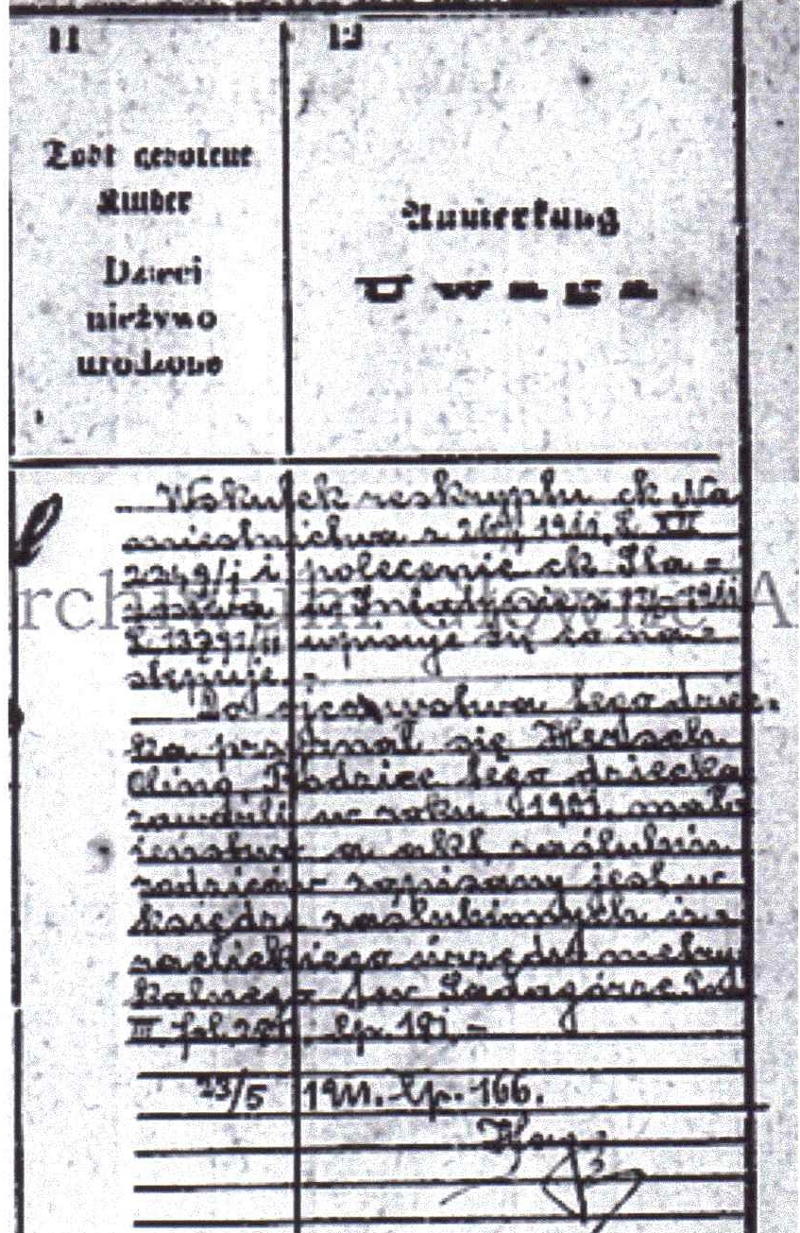
Below is a copy of my grandfather Rubin’s birth entry but need help to translate the “Anmerkung”.

Rubin was born in Zablatow in 1881. His mother was Bruche Singer. His father was Hersch Ohling. When Rubin married in 1908, he was still known as Rubin Singer. His name was changed to Rubin/Robert Oling, possibly in 1917.

I wonder if the “Anmerkung” relate to any additional family history that I can discover from the document.

I would be grateful if this segment of the document could be sent to all list members as someone might understand the language.

Thank you and very best wishes to all.
Jean Weightman

Rubin-a

The “Czernowitz Imperial-Royal I. State Gymnasium” Graduates 1850-1913


Download: 1850-1913: State Gymnasium Graduates in Alphabetical Order (3,011 Data Sets)
Download: 1850-1908: Annual Report 1909/1910 and Graduates in Chronological Order (Overall Listing)
Download: 1808-1908: Festschrift to the Centennial Celebration of the State Gymnasium (German)
Download: 29.10.1908: Czernowitzer Allgemeine Zeitung Report on the Centennial Celebration (P.1-3)
Download: 29.10.1908: Bukowinaer Post Report on the Centennial Celebration (P.3-4)


Source: Digital Collection Heinrich Heine University Düsseldorf for the years 1900-1913
Source: Digital Collection Podkarpacka Digital Library for the years 1869-1913

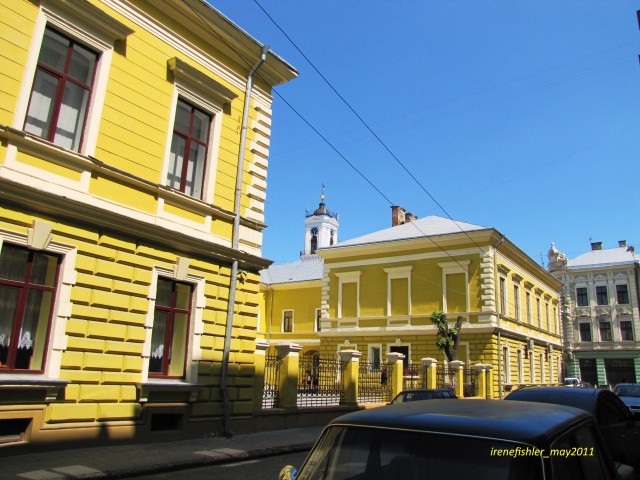
1.Gymnasium_vul.Sterna(Bankgasse)_2011
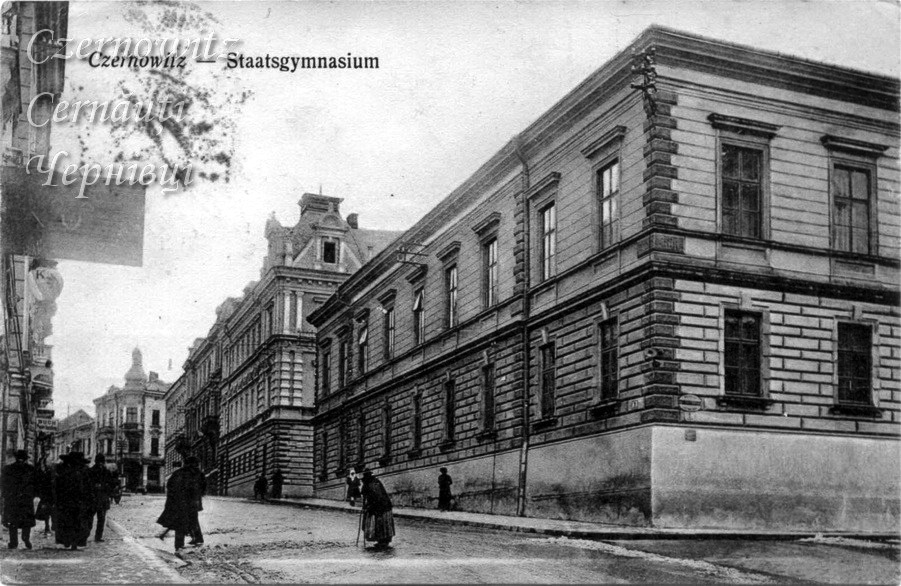
The “Czernowitz Imperial-Royal I. State Gymnasium” in May 2011.

OLYMPUS DIGITAL CAMERA
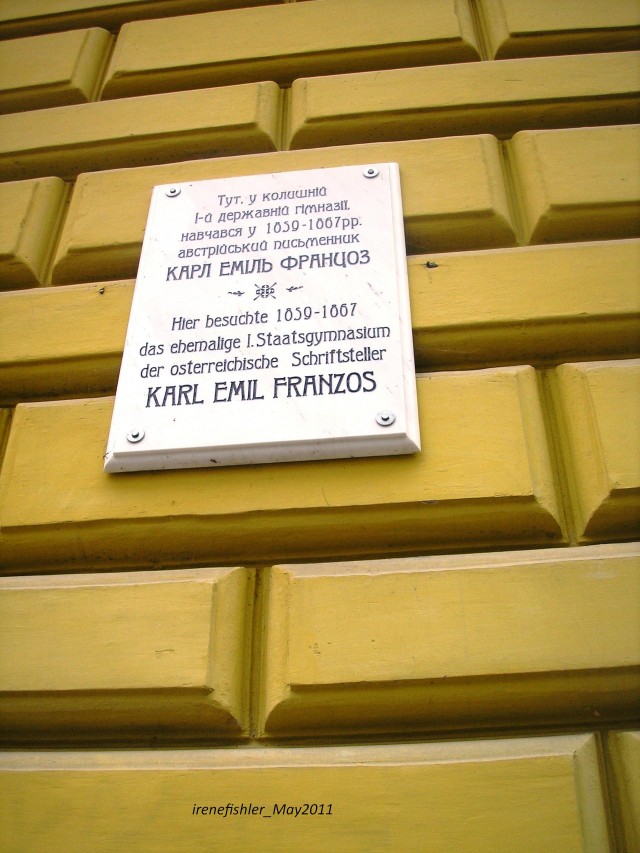
Karl Emil Franzos graduated in 1867.

OLYMPUS DIGITAL CAMERA
Mihai Eminescu attended the State Gymnasium between 1860-1863.

K&K Juden

By way of Peter Elbau and Cornel Fleming:

Aus dem Rundbrief Nr. 113 der ARGE Feldpost Österreich-Ungarn, Autor: Horst Taitl
[From the circular letter No. 113 of the Working Field Post Austria-Hungary, Author: Horst Taitl]

Click on the link below:
Juden in der Armee
Jews in the Austro-Hungarian Army as seen through WWI military conrrespondence. — in German with photographs.

Dr. Markus Krämer, Another Notable Czernowitzer

Dr.Markus Kraemer
Dr. Markus Krämer (27.10.1887 – 02.06.1964), President of the Local Commitee of the General Zionists, lawyer, local council, Deputy Party Chairman of the Jewish Party for the Bukovina, member of the student’s corporation J.N.A.V. Zephirah in Czernowitz:

Click on the pictures to enlarge!

1938, row by row, from left to right: Prof. Baruch Schuller, Adv. Iosef Brender, Hans Blutstein, Dr. Ad. Kliegler, Mag. M. Geller, Dr. Ad. Ziller, Adv. L. Seidner, S. Weisselberger, Dr. Iak. Krell, Adv. Ch. Saller, Prof. I. Grünberg, Ing. D. Kronenfeld, S. Picker, Adv. Noe Lehrer, M. Schwarzkopf, Adv. I. Kirmayer, Max Reinstein, Prof. B. Eisenthal, Dr. Srul Osterer, Dr. Fr. Nasspreis, Bernh. Scherzer, Dr. Adele Fleischer, Salo Woraczek, Dr. L. Brenner, Osn. Osterer, Willy Kliegler, Eva Schieber Fiedler, Dr. Abr. Kaswan, Dr. Saul Klier, Isak Fernhof, L. Eifermann, Dr. Ulrich Schächter, Iosef Bickel, Dr. Hersch Lecker, Dr. Meinh. Roth, Dr. Paul Lessing, Adolf Feldmann, Adv. M. Schapira, Dr. L. Mader, Dr. Josef Thau, Dr. M. Wiesenthal, Dr. B. Kasvan, Dr. Bernh. Kahane, Sim. Rosenrauch, N. Linker, M. Weissmann, S. Habermann, Mend. Zucker, Adv. M. Abramovici, Calm. Katz, Ing. Isr. Stenzler, Dr. Fritz Wagschal, Ios. Kinsbrunner, Dr. Wilh. Stecher, Dr. Iacob Iekeles, Rudolf Katz, Dr. Iacob Geller, Dr. Bernh. Stecher, Dr. Leonh. Eckstein, Prof. Isr. Schleyer, Prof. Dav. Lesczer, Leo Wiener, Samuel Stieber, Dr. Benj. Lessner, Dr. Ios. Diwer, Dr. Sal. Harnik, Dr. Salo Krässel, Dr. Norbert Kiwe, Dr. Moriz Zalman, Karl Metsch, Dr. Samuel Hammer, Chaim Osterer, Dr. Emanul Wagner, Adv. Aron Hechtlinger, Dr. M. Diamant, Dr. Moses Bardich, Prof. Dr. S. Hornstein, Dr. Mar. Sommer, Dr. Ios. Kaufmann, Prof. M. Herbst, Prof. Teod. Kern, Dr. Isid. Kottlar, Dr. Mark. Krämer [Dr. Markus Kramer], Dr. Karl Hasko, Dr. S. Brettschneider, Dr. Wolf Herzberg, Dr. Iosef Sperber, Dr. Saul Geiger, Dr. Ad. Niederhofer, Dr. Herm. Ebner, Dr. Mos. Glaubach, Dr. Ios. Miseles, Dr. Mordko Rotfeld, Iakob Czaczkes, Mos. Seidmann, Adv. Iak. Hasenfratz, Iosef Kula, Adv. Israel Goldhagen, Abrah. Friedmann, Adv. Herm. Lifsches, Dr. Heinr. Kreisel, Dr. Wolf Riznik, Adv. Simon Stein, Osico Wolfshaut, Adv. Herm. Spasser, Adv. Laz. Fränkel, Adv. Er. Kupferberg, Adv. Izio Halpern, Adv. M. Hammer, Adv. Max Halpern, Mag. Ak. Finkental

LES ARPENTEURS – Le tourisme de la mémoire

LES ARPENTEURS : LE TOURISME DE LA MÉMOIRE

Dans les rues de Tchernivtsi, en Ukraine, Sylvie une jeune retraitée française, cherche l’ancien atelier de son oncle tailleur. Sa famille a perdu sa trace en 1941. À Lviv, autre ville ukrainienne, c’est Antonin, étudiant de 22 ans, qui entame avec sa grand-tante un périple émouvant dans son histoire familiale. Eux aussi sont à la recherche d’un aïeul disparu. Quant à Orane et Rémi, frère et sœur d’une trentaine d’années, c’est la Pologne qu’ils sillonnent, enquêtant sur la disparition de leur grand-oncle Léon.

Chaque année, de nombreux Français consacrent leurs vacances à tenter de retracer le destin de leurs ancêtres juifs. Ces derniers vivaient en Europe Centrale où des familles entières ont été les victimes de ce que les historiens appellent la « Shoah par balles ». Ainsi, en Ukraine, plus d’un million de Juifs ont été fusillés par les Nazis.

Ces touristes de la Mémoire portent un nom : les Arpenteurs. Ils sont aidés par des guides locaux qui préparent leur voyage, collectent indices et documents d’archives, repèrent les lieux ou retrouvent des personnes qui ont pu connaître leurs parents disparus. Un long travail fait de patience et d’obstination qui permet, parfois, de renouer les fils d’une histoire familiale souvent tragique.

Un reportage en forme de témoignage signé Renaud Lavergne et Vincent Barral

Berezhany: My City, My Pride

In Berezhany, a town in the Ternopil region of Western Ukraine, a group of local students discover their history.

Jeremy Borovits: First off, thank you for your responses, and for watching the film. It has been interesting for me to hear all of your thoughts about the topic.

My first point is this: In no way, shape, or form was my goal to exculpate Ukrainian participation in the Holocaust. I have been living in this country for three and a half years, and I am well aware of the role some Ukrainians played. The goal was to try and get the students to realize that the history of what happened in Berezhany is a part of their history, whether it happened to Jews, Ukrainians, Poles, Roma, or Armenians.

Judaism, as well as the Holocaust, is not taught very well in Ukraine. A part of this is certainly due to the role many Ukrainians play. But it is much more attributable to the fact that the Ukrainian education system is rife with corruption and is still based on the old Soviet model. All history taught in Ukraine is either Soviet-centric, Russo-centric, or Ukrainian-centric. This is a problem with how they approach history, not some deep rooted evil that lies within them.

Along that note, I have lived in Ukraine for three and a half years, and at least one conclusion I have come to is this: NOT ALL UKRAINIANS ARE ANTI SEMITIC. Are there anti-semites here? Yes, certainly. But in the time I have been here, I have never experienced any active anti-Semitism. This past Shabbat I was in New Jersey, and while walking home from synagogue someone yelled “Kike” at me from their car. And this was in New Jersey.

There were Ukrainians who participated in massacres during the war. There was a very small minority who risked their lives to save Jews. But the VAST majority was simply trying to survive. Their lives and the lives of their families were at risk. To hold all Ukrainians responsible for what happened is both historically inaccurate and morally wrong. In 1932-1933, Stalin exacted a famine on the Ukrainian people (as wel as some other nationalities.) Millions of people were starved to death (probably around 3 million). Lazar Kaganovich, a Jew, was one of the Soviet officials who executed the famine. To hold all Ukrainians as responsible for the Holocaust is to say that all Jews were responsible for the Holodomor (the name given to the famine.)

History is not, and will never be, black and white. We all have our own emotions that factor into the equation, the memories handed to us by our parents and grandparents and beyond. The challenge for all of us, and especially in projects like this, is to see the Grey.

No one had ever talked to these students before about Jews. They knew nothing. And now they know something. And they for sure, throughout the course of the project, got to know many Jews of various sizes, religious observance, and facial hair. I cannot guarantee that they have all changed. But I do get the sense that the next time someone says something about the Jews, these kids will stand up.

One last point to make: I am sure that all of you who have seen the film remember the man with the large mustache and the hat who spoke of the Jews drinking the Ukrainian’s blood. What didn’t make it into the final cut was the students arguing with him. How can you think that, they asked. How can you believe that? How can you not see that a person is a person.

I truly believe that hatred will breed hatred, and love will breed love. Teaching our children that we are all equal, that we are all individuals, and that every human life is sacred, is, for me, the best weapon against hatred, the best support for love.

This is a difficult topic, and the making of this film was a difficult process. I am sure some of will accuse me of naivety, or blindness, or perhaps of being a self-hating Jew. I can only tell you that it was while living in a Ukrainian village that I found Hashem, and my neighbors and students were there to support me.

If you have a response I welcome it, both via the forum as well as privately, if it makes you more comfortable.

All the best

Jeremy